The field of Statistical Process Control has this interesting idea that ‘management is prediction’ — i.e., in order to be a good operator, you need to be able to predict (within limits) the business outcomes of your actions.
The implications that flow from this are quite useful. (View Tweet)
Note: Thread
First, most business operators run their businesses according to ‘superstition’ — meaning they believe some set of things will happen due to their actions, and then they take those actions, but they don’t really KNOW if there’s a causal relationship.
This describes me too, btw. (View Tweet)
W. Edwards Deming then has a follow up idea: he says that “there is no truth in business, only ‘knowledge’”
And ‘knowledge’ is defined as “models or theories that allow you to predict better”.
Whenever you see an SPC practitioner talk about ‘knowledge’, this is what they mean. (View Tweet)
Put these two ideas together, and you have the resulting worldview:
“To become rigorous operators, you need an org-wide commitment to the pursuit of ‘knowledge’, which are models of the business that allow you to predict better.”
I call this the ‘process control’ worldview. (View Tweet)
So, wait, what does this mean?
It means that you develop practices or tools that force your org to become ever better at predicting the outcomes of business actions.
The Amazon Weekly Business Review is one such tool (descriptive section linked): https://t.co/agx1As4zuM (View Tweet)
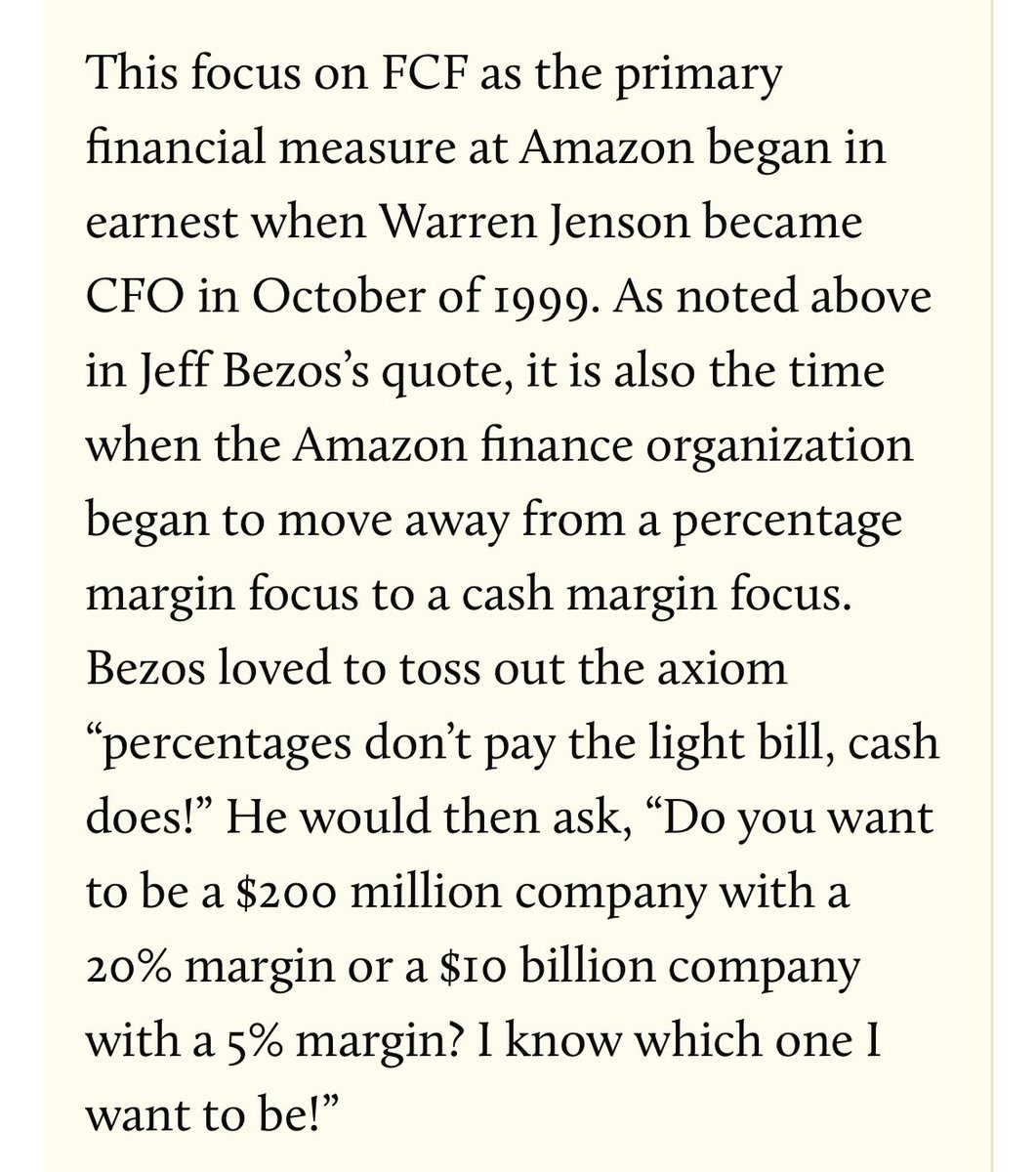
Another example of this worldview in practice is the FCF forecasting tool that Amazon developed in the early 2000s, shortly after Warren Jenson became CFO.
Why? Because MANAGEMENT IS PREDICTION — if FCF is your primary financial measure, why not make it easier to predict?
(View Tweet)
Note: Critical metric
The point I’m trying to make here is that the ‘process control’ worldview is what is important to internalise.
All the data tools in SPC, all the org design experiments that Amazon did, all the processes they developed, are really in service of this worldview. (View Tweet)
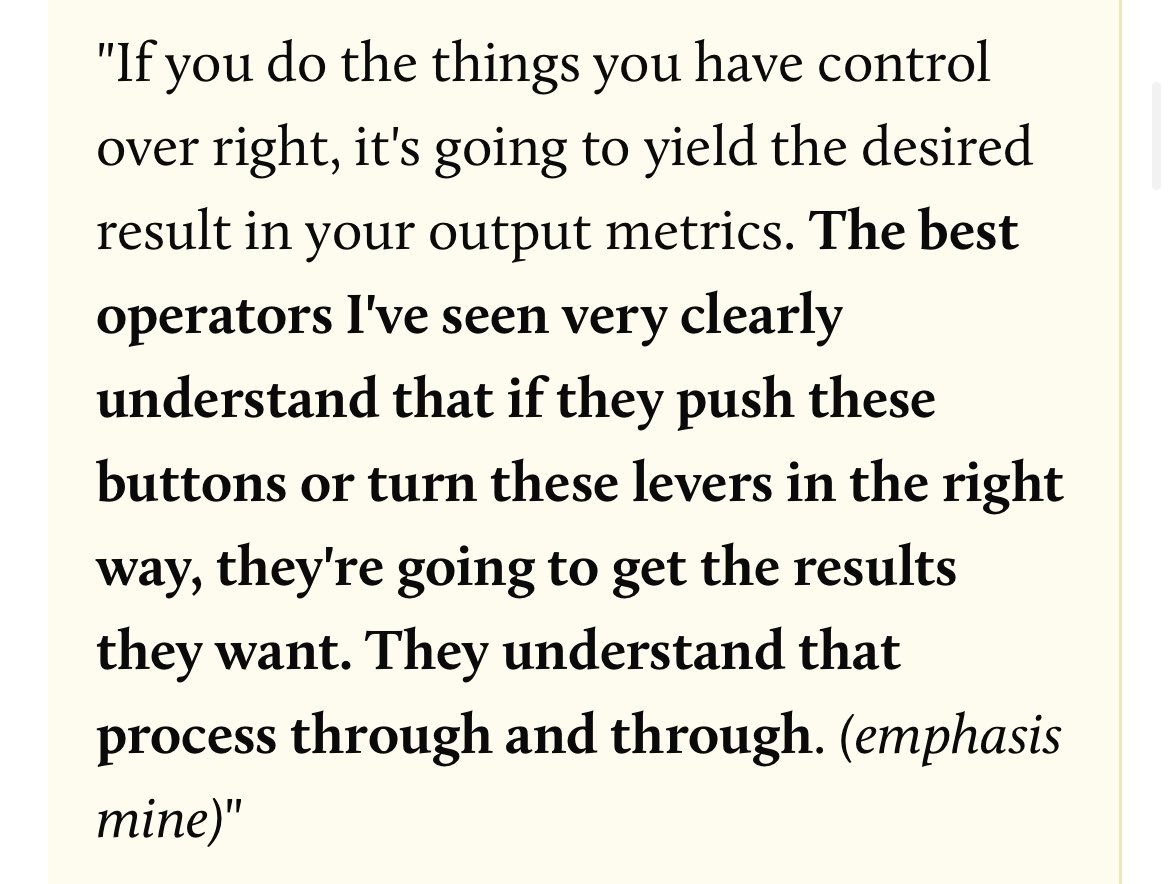
But the basic idea is simple to grok: if your business is a process, wouldn’t you want to figure out what input metrics you can manipulate in order to change the outputs?
Rinse and repeat for every sub process in every sub system of your org.
(View Tweet)
SPC actually has more concrete recommendations to get to ‘knowledge’.
For starters, they have this thing where they say “understanding variation is the beginning of knowledge”.
Simple idea, but rather profound: (View Tweet)
The idea is that when you’re looking at business data, you need to know if the changes you’re looking at are the result of normal variation, or exceptional variation.
If it’s the former, ignore.
If it’s the latter, investigate. The latter will LEAD to knowledge. (View Tweet)
Why? Simple: exceptional variation means there are several underlying, unknown causes that are affecting your business outcomes.
If you can identify those, you can remove them, OR you can manipulate them.
Doing either thing results in better prediction. (View Tweet)
Since identifying and understanding variation is SO CRITICAL to ‘knowledge’ in business, it’s no surprise that SPC has a set of simple tools that it recommends that every operator start using.
The tools are ‘process control charts’ or ‘process behaviour charts’. (View Tweet)
I won’t go into the nuances of using the charts in this thread (they’re NOT a panacea, and it takes a certain amount of skill to use them), but I’ve done an initial deep dive here (members only): https://t.co/9Knap62Kmc and plan to write more when I’ve got more practice with them (View Tweet)
I should note that Amazon doesn’t use such charts; they have another approach that results in the same outcome (org understanding of variation).
The key thing is really the worldview: the idea that you need to constantly design processes and tools to improve prediction! (View Tweet)
Ok, tl;dr:
Management is prediction, which means:
If you want to become operationally excellent, what you need is an org-wide pursuit of ‘knowledge’, which is defined as ‘theories or models that enable you to better predict the business outcomes of your actions’. (View Tweet)
What this actually looks like: practices or tools that create a predictive, shared model of your company. This may take on many forms: e.g. the Amazon WBR, a monthly Process Behaviour Chart review, a FCF forecasting tool, or a master growth model that everyone operates against (View Tweet)
I’m still digging into all the practical implications, but I think at this point, the core lesson is clear.
Want to know what it means to become data driven in business? In a sentence: it means the pursuit of ‘knowledge’, in whatever form it might take for your business. (View Tweet)
Most of my explorations are written out in essay form first, and only published on Twitter later.
Read the full series here: https://t.co/FCfhkkkem6 (View Tweet)

 (View Tweet)

 (View Tweet)