Module 3: Offer Creation
Welcome!
Hey there!
Welcome to Module 3 of Low-Ticket Product Creation, a mini-course inside of Low-Ticket Launchpad.
In this module, we’re going to talk about Offer Creation—specifically:
A checklist of things you need to speak to in your offer to make it compelling enough to buy
How to come up with creative ways of price anchoring to the upside or downside
And the importance of naming your digital product something tangible (opposed to intangible)
Now, Offer Creation is a bit of a rabbit hole.
It’s one of those skills that is fairly easy to learn and execute as a beginner, but also one of those skills that takes a lifetime to master—because there are so many different ways you can approach it, and levels you can take it to.
For the purposes of this module, I’m going to keep things as simple and actionable as possible.
And if you haven’t already, I strongly encourage you to grab a copy of $100M Offers: How To Make Offers So Good People Feel Stupid Saying No by Alex Hormozi. That book will take you down plenty of different rabbit holes when it comes to offer creation.
Let’s dive in!
What Is An “Offer?”
An Offer is, quite literally, what you are offering the customer.
The simplest version of an Offer looks like this:
What problem are you helping the customer solve?
And how?
For example:
“I will help you fix your golf swing and hit the ball 250 yards.”
“…by giving you 10 simple wrist exercises to strengthen your forearms.”
But this is just the most basic form of an Offer.
In reality, there are all sorts of other levers you can push-and-pull to make your offer even more compelling…
Even more compelling…
Even MORE compelling…
EVEN MORE compelling.
So, that’s my goal here—to give you a checklist of things that, when stacked on top of each other, make your Offer more and more and more compelling (until eventually, it becomes irresistible).
Offer Creation Checklist
Some quick context:
What I am about to share with you has not just worked “once” for me and our businesses.
It has worked over, and over, and over again.
This Offer Creation checklist is how I think about positioning, packaging, marketing, and selling every single digital product we drop and new business we start.
It’s how:
Ship 30 for 30 has generated millions of dollars in revenue
Premium Ghostwriting Academy has generated millions of dollars in revenue
Typeshare has crossed $1M in lifetime revenue
Write With AI has crossed $1M in lifetime revenue
Digital Press, my ghostwriting agency, generated millions of dollars in revenue
And all of our $350 digital product drops have generated hundreds of thousands of dollars in revenue in 10 days or less (and millions of dollars in combined revenue over the years).
So yes, it works—and it works across all sorts of different niches and business models.
It doesn’t matter what industry you’re in, who your customer is, or what product you’re selling… your Offer needs to hit these notes in order to make it sing.
So, here’s the checklist, and then we’re going to walk through each piece.
Offer Creation Checklist
✅ Specific Problem
✅ Solved For A Specific Person
✅ Solved In A Specific Way
✅ Achieving An Objective Outcome
✅ In A Specific Time Frame
✅ Price-Anchored To Upside 5x-10x What You’re Charging
✅ Or Price-Anchored to Downside 5x-10x What You’re Charging
✅ Named Something Tangible
✅ Positioned In A Niche Where You Have Experience
✅ And Proof It Works
Let’s walk through each one.
Offer Creation Piece #1: Specific Problem
Repeat after me:
Whoever frames the problem owns the solution.
Whoever frames the problem owns the solution.
Whoever frames the problem owns the solution.
Whoever frames the problem owns the solution.
Whoever frames the problem owns the solution.
If I successfully educate you on a problem, you automatically assume I am equipped and qualified to help you solve it. (Otherwise, how would I be able to articulate your problem so accurately?)
This is the first thing.
The second thing (again, repeat after me):
The customer can’t care about your solution until they first care about their problem.
The customer can’t care about your solution until they first care about their problem.
The customer can’t care about your solution until they first care about their problem.
The customer can’t care about your solution until they first care about their problem.
The customer can’t care about your solution until they first care about their problem.
You could have the best “solution” in the world. But the customer will not be able to see the value in your solution UNLESS they have first been made aware of:
A) A problem they didn’t know they had, or…
B) A problem they know they have, but haven’t gotten around to solving.
A lot of times, where digital product creators go wrong is they spent a LOT of time thinking about how to make the best product/provide the best solution.
But fail to address (and accurately speak to) the true problem they’re solving.
Pro Tip: Lead with 1 specific problem.
Selling digital products is more about leading with the right problem to solve, rather than building the perfect product.
Let me give you a quick little crash course on “positioning.”
If you try to lead with 10 problems, the customer doesn’t know which of the 10 is the priority. (And if you say they’re “all” the priority, then none of them are the priority.)
But if you lead with 1 problem, the customer immediately knows where to put you in their mind. (And then, once you’re “in their mind,” you can educate them on the other problems you ALSO help them solve, too.)
So take your list of 10 Biggest Problems, and pick the Most Important One.
Lead with that.
For example: Ship 30 for 30 = “We help you build a daily writing habit.”
Now, do we ALSO help writers solve all the other problems we know are important?
Yes.
But we LEAD with one: you aren’t writing consistently, and we can help you fix that.
Offer Creation Piece #2: Solved - Specific Person
The second piece of your offer is naming a specific person.
*Note: While you CAN get away with having a digital product that just solves a Specific Problem in a Specific Way (”I’ll help you build a Notion Time-Tracking Dashboard for your cold outreach so you stop wasting so much time managing your sales process”), it’s much more effective to NAME a specific target buyer.
For example, notice the differences:
“I help SalesForce contractors build a Notion Time-Tracking Dashboard for cold outreach so you stop wasting so much time managing your outbound sales process.”
“I help founders of marketing agencies doing <$3M in yearly revenue build a Notion Time-Tracking Dashboard for cold outreach so you stop wasting so much time managing your outbound sales process.”
“I help freelance graphic designers build a Notion Time-Tracking Dashboard for cold outreach so you stop wasting so much time managing your outbound sales process.”
In many ways, it’s the same “product” solving the same “problem.”
But notice how differently you would speak to the benefits of solving that problem, and using this product, for each audience:
SalesForce contractors have very different problems, workflows, and lifestyles than…
Founders of marketing agencies doing $3M in yearly revenue, than…
Freelance graphic designers who are brand new to sales.
To help you identify a “specific person” you can help, think about the following categories of people in your target niche struggling with the 10 Biggest Problems you’ve identified:
Experience Level: Are you helping beginners, people who are moderately proficient, or industry veterans with 10+ years of experience?
Job Title: Are you helping freelancers, contractors, gig economy workers, consultants, full-time employees, and/or someone with a very specific job title? (Ex: “Head of Affiliate Partnerships”)
Language: Are you helping people in English? Spanish? French? German? Etc.
Life Transition: Are you helping people who just experienced some sort of large life event? Just got divorced, just got pregnant, just had their first kid, just got laid off, just moved cities, just got a promotion or raise, just changed careers, etc.
Purchasing Power: Are you helping people with no money? People making $10k/mo+? People with a net worth in excess of $1M?
There are infinite ways to “get more specific,” but these should help you narrow down who it is you’re really trying to help.
Pro Tip:
If you’re really not sure, just pick your Specific Person by experience level.
It’s very easy to determine whether you’re building a product for “beginners” or “people who are proficient, but don’t know how to {solve a specific problem}…”.
(And if the voice in your head is screaming, “But COLE?! My product helps BOTH of them!!!” tell that little voice to sit in the corner and pick one. If both are the priority, neither is the priority. Pick. One.)
Offer Creation Piece #3: Solved In A Specific Way
The third piece is to be extremely clear about the “way” in which you help this Specific Person solving this Specific Problem.
One of the biggest mistakes digital writers & creators make is they don’t make the “Specific Way” clear.
For example, notice the difference between these two sentences:
A) “I help freelance graphic designers stop wasting so much time managing your outbound sales process.”
B) “I help freelance graphic designers build a Notion Time-Tracking Dashboard for cold outreach so you stop wasting so much time managing your outbound sales process.”
In example “A,” the “way” you help this Specific Person solve this Specific Problem isn’t specified. As a result, yes (if this is “you”) you resonate with being that Specific Person, and you probably resonate with that Specific Problem… but you’re still unclear about the promise of how you’re going to solve it.
This mistake gets compounded when the digital writer/creator tries to speak to the “Specific Way” but makes it vague, open-ended, and intangible.
They do something like this:
- “I help freelance graphic designers stop wasting so much time managing your outbound sales process by up-leveling their approach.”
The digital writer/creator thinks “up-leveling their approach” is sufficient—but it’s not.
It’s vague: we have no idea what that means.
It’s open-ended: we don’t know how to define success.
And it’s intangible: we can’t hold or measure “up-level their approach.”
But all of these problems get solved when we make the Specific Way clear and, more importantly, TANGIBLE:
- “I help freelance graphic designers build a Notion Time-Tracking Dashboard for cold outreach so you stop wasting so much time managing your outbound sales process.”
It’s the specificity and tangibility that makes the Specific Way compelling.
So, how do you make your Specific Way tangible?
Think about how to deliver some sort of “physical,” digital asset:
Roadmap
Blueprint
Checklist
Excel Template
Notion Dashboard
Keynote Presentation
Data Analysis Whitepaper
30 Pieces Of Published Content
Etc.
The whole secret here is to make the “Specific Way” you solve this problem, for this person, TANGIBLE.
It has to feel like they are getting an object of some kind—otherwise it’s hard for the customer to evaluate why this is valuable and/or how they will objectively measure success.
Offer Creation Piece #4: Reaching A Clear Outcome
Which dovetails nicely into the fourth piece here, which is promising the achievement of an OBJECTIVE outcome.
Now, what is an Objective Outcome?
Well, let’s start with what a Subjective Outcome is first:
“I’ll help you live the life of your dreams.”
“I’ll help you finally be the person you want to be.”
“I’ll help you make that transition and be your best self.”
This is what most digital writers, creators, authors, and even executives at billion-dollar companies do—and it’s one of the biggest mistakes in all of marketing.
A Subjective Outcome means, if you ask 10 different people to tell you what “that outcome” is promising, you will hear 10 different answers. And if everyone is giving you a different answer, that means nobody actually knows what’s being promised… which is a huge problem!
An Objective Outcome is something binary.
You can measure it.
For example:
“I’ll show you how to land your first $5,000 ghostwriting client.”
“I’ll show you how to buy your first single-family rental property.”
“I’ll show you how to overcome your fear of social anxiety and go on your first 5 dates.”
All of these outcomes are Objective because they either happened… or they didn’t.
Now, here’s the nuance when it comes to digital products (VERY IMPORTANT):
When you are selling a low-ticket digital product ($350 or below), fundamentally that means you are selling information.
What you probably aren’t selling (at that price point) is:
Coaching
Weekly Accountability
Implementation & Consulting
Real-Time Question/Answer Communication
Live sessions, content reviews, ongoing support, etc.
At its core, this is what separates low-ticket from high-ticket products.
Low-ticket products sell information (Do-It-Yourself).
High-ticket products & programs sell information + some form of implementation (Done-With-You, or in some cases, Done-For-You).
So, when you are creating your low-ticket product offer, you have to be VERY clear about what exactly you’re promising the customer.
Because there is a cataclysmic difference between these two promises:
“If you use this strategy, I guarantee you will attract your first 10,000 followers.”
“If you use this strategy, you will have everything you need to attract your first 10,000 followers.”
The first promise is bad. (Which is why online education has such a stigma attached to it—because people do this all the time.) And it’s bad because you don’t have control over the implementation. You HOPE the customer will follow your strategy. You HOPE they will do what you tell them. But ultimately, since they aren’t paying you beyond the implementation, you really don’t have any control over what they do or don’t do—which means promising and GUARANTEEING an outcome is a mistake.
The second promise is good. You aren’t promising that they will ACHIEVE that outcome. You are promising that you will give them everything they need in order to work hard and achieve that outcome on their own. You are giving them the INFORMATION. The implementation is up to them.
This nuance is extremely important, because you don’t want to promise things you can’t deliver.
Offer Creation Piece #5: In A Specific Time Frame
Now this piece isn’t required, but if you can add it… your Offer immediately becomes more compelling.
Notice the difference:
“I’ll help you build your first 10 automations with AI.”
“I’ll help you build your first 10 automations with AI in 72 hours (or less).”
Adding in a time constraint makes an Offer more valuable because it also makes it more urgent.
Urgency is the secret:
You can add urgency simply by stating the amount of time overtly.
You can add urgency by making “something big” feel like something small, manageable, and quickly achievable.
And you can add urgency by REMOVING a large time investment.
For example, this was a big reason why Ship 30 for 30 was so successful (and why so many other programs immediately copied our approach):
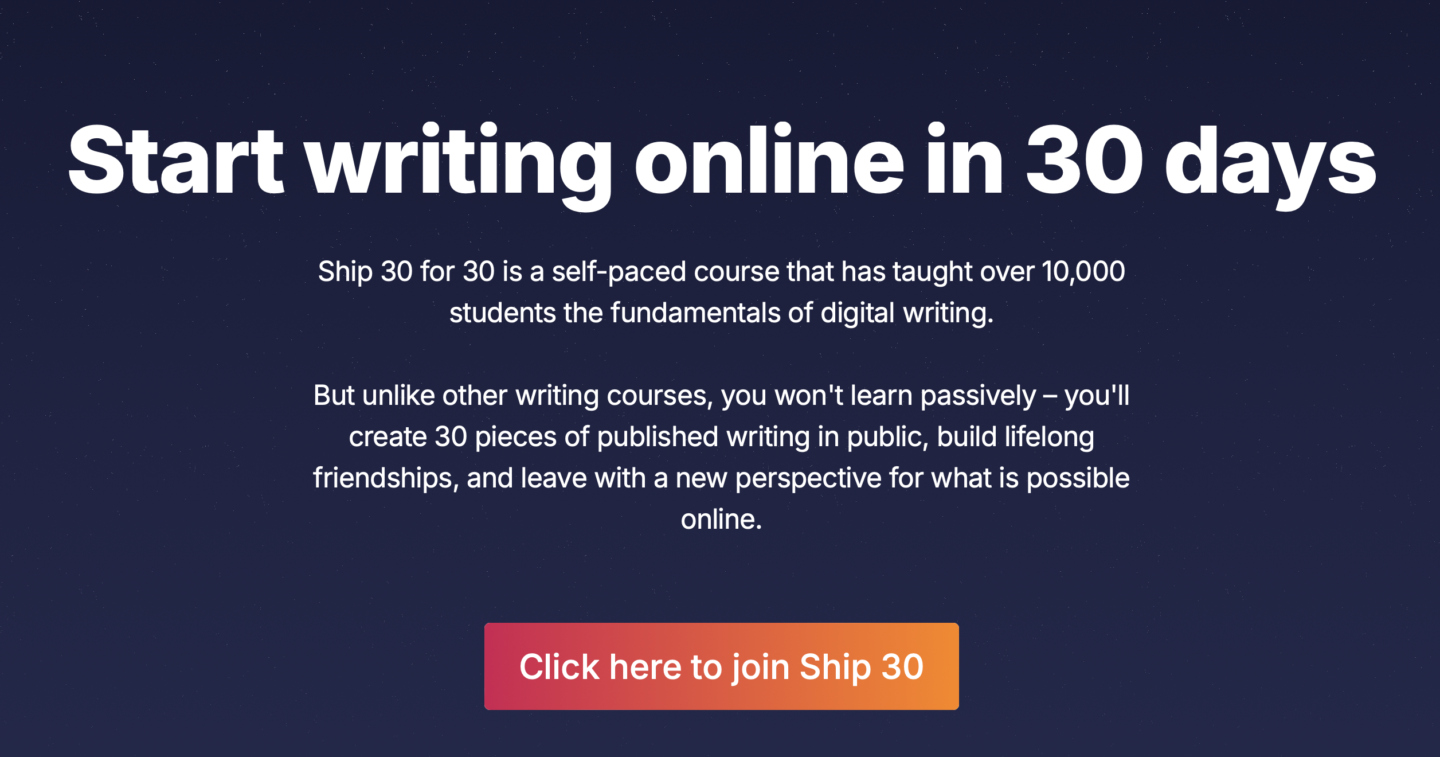
In Ship 30 for 30, we didn’t just promise beginner writers: “You’ll learn how to start writing online.”
For many of them, they had been TRYING to write online for YEARS! Time was actually a problem.
So, we compressed the timeframe down—making the Offer exponentially more valuable:
“We will help you start writing online in 30 days.”
Offer Creation Piece #6: Priced 5x-10x (the Upside)
Now this piece isn’t necessary something you need to lead with—but it can be a very powerful piece to speak to in:
Your marketing materials
On your landing page
In your emails
Etc.
You want to make the customer aware of all the positive outcomes (and “upside”) that can happen IF they solve this specific problem in their life and IF they take action.
Money: “Here’s how much money you could make if you solved this problem with this new skill.”
Time: “Here’s how much more time you could have, if you solved this problem.”
Status: “Here’s all the cool things that will happen, and all the recognition you’ll get, and all the doors of opportunity that will open when you solve this problem.”
For example, you might have noticed how we did this in marketing Low-Ticket Launchpad (which you’re going through right now!).
We used this technique and said:
“You pay $350 once, to acquire the skill of selling as many $350 products as you want for the rest of your life.”
That’s price-anchoring to the upside.
Offer Creation Piece #7: Priced 5x-10x (the Downside)
This piece can also be in your core Offer, but it’s more likely to just be a talking point in your marketing emails.
Price-Anchoring to the downside means making the customer aware of what happens if they don’t take action.
Now, I’m not talking about fear-mongering.
I just mean making them aware of the risks, the hidden costs,
Tell the truth!
Let’s use a dentist’s office as an example here:
“If you don’t get Invisalign and fix your bite, you’re going to keep grinding your teeth.”
“If you keep grinding your teeth, you’re going to suffer more cavities.”
“And if you suffer more cavities and your teeth continue to break down, you’re going to have to get multiple root canals later in life.”
When you successfully educate customers on what happens if they DON’T fix this problem, they become emotionally connected to the problem. And when they become emotionally connected to the problem, they sell themselves.
And one of the most effective ways of doing that is to simply tell them what bad things will happen if they don’t take action and fix this problem—once and for all.
Ways you can price-anchor to the downside:
**FOMO: “**How much money will you miss out on if you don’t fix this problem/take action?”
Lost Time/Money: “How much time/money will you lose if you don’t fix this problem/take action?”
Emotional Regret: “How will you feel, at this point in the future, if you don’t fix this problem/take action?”
Opportunity Cost: “If this problem persists and you don’t fix it, and it keeps eating up time/money, what other things that you care about will you miss out on?”
Offer Creation Piece #8: Named Something Tangible
This might be the most important part of Offer Creation, and it’s something a) I don’t hear many people ever talk about, and b) I notice the VAST majority of digital writers/creators struggle with.
Your Offer has to be tangible.
What does this mean?
Well, let’s start with what it DOESN’T mean.
Intangible Offers:
“I’ll help you up-level your sales skills.”
“I’ll show you how to become the person you were meant to be.”
“I’ll give you what you need to be a successful change-maker in the world.”
In the same way you want to speak to an Objective outcome and not a Subjective outcome, you also want your Offer to be anchored to something TANGIBLE—not intangible.
Intangible offers are things you can’t hold, can’t measure, can’t feel, and can’t “collect.”
They’re not objects—they’re loose phrases with lots of vague, implied meaning.
The problem is, this is how EVERYONE speaks. And so conventional wisdom says, “Well if this is what everyone else does, I should probably do the same.” But this is one of the biggest mistakes that gets made in marketing. YOU DO NOT WANT YOUR OFFER TO BE INTANGIBLE.
How to make your Offer TANGIBLE:
In your Offer, you either want the WAY you help the customer solve their problem be Tangible—or you want the OUTCOME to be Tangible.
(And bonus points if you can make both Tangible!)
For example, can you spot the “tangible” promise/offer for Ship 30 for 30?
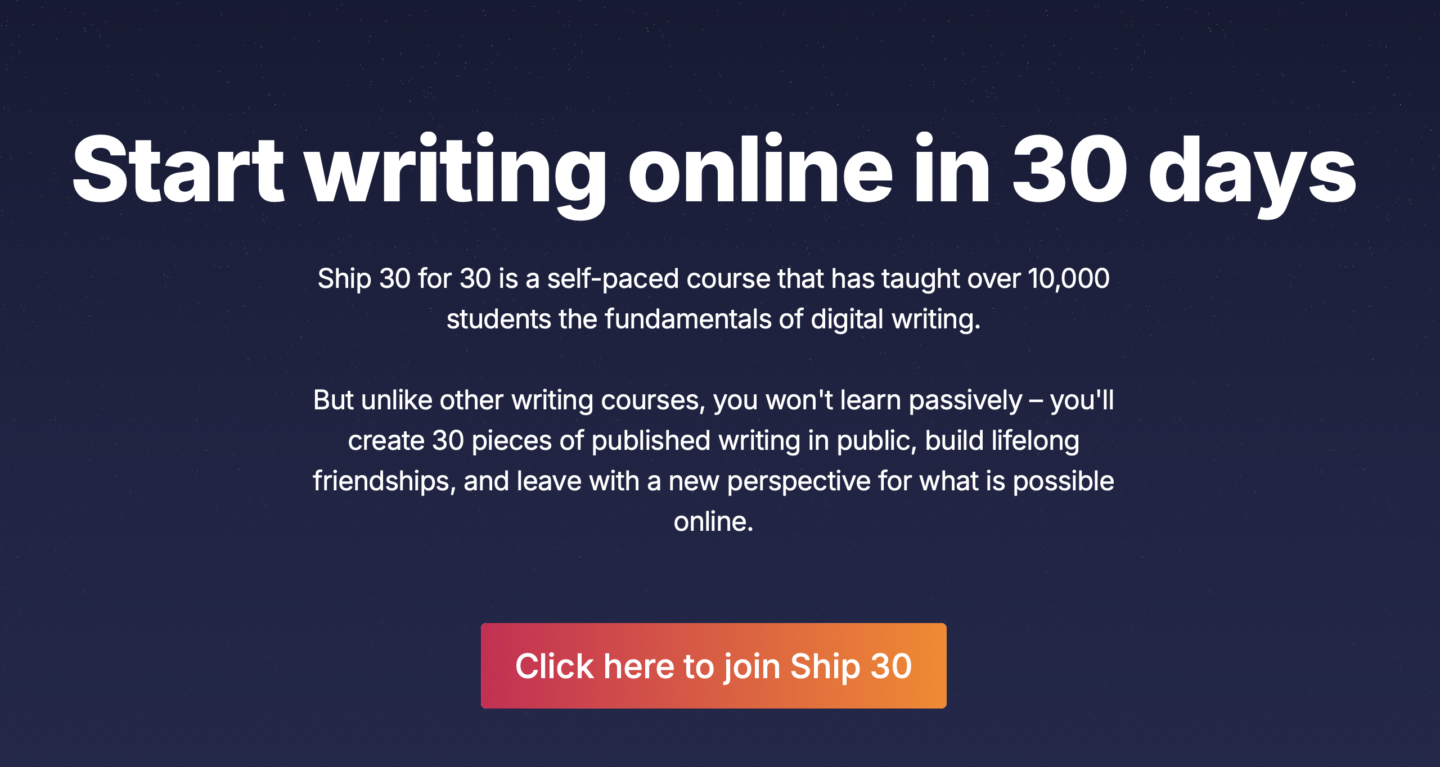
It’s so simple, but so powerful:
“You’ll create 30 pieces of published writing in public.”
This is TANGIBLE.
You can “hold” 30 pieces of writing.
You can measure 30 pieces of writing.
You can feel and “collect” your 30 pieces of writing.
And it’s Objective—you either wrote 30 pieces, or you didn’t.
The Tangible x Objective combination of your Offer is, in my opinion, the most important part of the entire game.
If you nail this, your Offer is impossible to ignore.
But if you don’t, and your Offer is Intangible x Subjective, it’s worthless—because the customer, quite literally, doesn’t know what you’re promising or why it’s valuable to them.
Offer Creation Piece #9: Positioned in Your Niche
This piece should be obvious, but you would be shocked how many people completely disregard this part of the Offer equation.
You should not launch Offers in niches where you have no experience.
You should not launch Offers in niches where you have no content library.
And you should not launch Offers in inches where you have no audience.
Any “Offer” you create should be based on:
Content you’ve already written for free
And content you’ve already validated in public
In a niche where you have compounding attention
If you are writing in one niche, but want to launch an offer in a completely different niche, STOP.
Or, if you haven’t started writing or creating content online yet, and want to skip straight to “building a product,” STOP.
These are mistakes.
For example:
I come up with product ideas every day.
But I don’t pursue 99% of them because they don’t always align with my niche and where I have compounding attention online.
Which means building those offers would be a complete waste of time.
(Even if some people bought the product, sales would pale in comparison to if I launched an Offer that spoke directly to my niche and core audience.)
But the real reason you only want to launch Offers in niches where you have compounding attention and are actively building experience (again: you don’t have to “be an expert”) is because CONTEXT MATTERS. And people want to buy products from people who visibly and consistently live and breathe their niche.
And they reject products from people who are just trying to capitalize on a trend.
Offer Creation Piece #10: And Proof It Works
Finally, the last piece of the puzzle is some sort of proof that it works.
Aka… stories & testimonials.
Proof Levels:
Level 1: “This worked for me.” In an ideal world, the low-ticket informational product you’re selling is exactly what worked for you. You should be your own case study. And this is the easiest form of proof because you’re control of all the variables. All you’re doing is sharing what you did, and the impact it had on your own life.
Level 2: “This worked for people like me.” The next-most-compelling form of proof is to show how other people like you (similar background, similar education, similar starting point, similar skills, similar limiting beliefs/problems, etc.) used your approach/asset/etc. and achieved similar results.
Level 3: “This also worked for people NOT like me.” This is where you really start cracking into true social proof territory. It’s one thing for your solution to work for you, or people like you. But your Offer carries a completely different weight and value when you can prove, “Oh and this also works for people who are NOTHING like me,” which allows you to tap into wider and wider audiences.
Level 4: “This has also worked across these different industries.” The next level up is showing how your solution doesn’t just work in one particular niche, but actually multiple niches. This is what dismantles the objection, “OK I see how that worked for you in that niche, but I’m in a different niche so I don’t think it will work for me.” Again, this allows you to tap into wider and wider audiences.
Level 5: “This has also worked for a long time.” Finally, the longer you stay in business, the more compelling your Offer becomes—because now it’s been tested by time. This is why building digital businesses is such a compounding game. The longer you do it, the more proof you acquire, the more credibility you have, the easier it is to launch your next Offer… and so on.
“But Cole?! What if I don’t have any proof/testimonials to start?!”
First of all, you should—because you should be your own case study.
Second, easy solution: give 10-20 people free access to your product to start, and ask them to be “beta-users” in exchange for a testimonial at the end.
Very easy way to power-level your first 10-20 testimonials and get the proof train rolling.
Low-Ticket Offer Creation AI Prompt
If you’re brand new to creating low-ticket digital products, I know this can be a lot to think about.
So, to make the process easier for you, I’ve created an in-depth AI prompt (trained on all of the information shared with you here) to help you generate some ideas for each variable inside your low-ticket product offer.
Simply paste this prompt into ChatGPT/Claude, and then in the second step give ChatGPT/Claude your niche/industry—and it will take care of the rest:
Step 1: Copy/paste the training prompt + tell AI your “niche-within-niche.”
AI will then give you ideas for each variable on the Offer Creation Checklist
I would like your help creating a bulleted list for my low-ticket digital product offer.
Here's the high-level checklist of the 10 different pieces I'd like to speak to in my offer (on the landing page, in my marketing materials, emails, etc.):
Offer Creation Checklist
✅ Specific Problem
✅ Solved For A Specific Person
✅ Solved In A Specific Way
✅ Achieving An Objective Outcome
✅ In A Specific Time Frame
✅ Price-Anchored To Upside 5x-10x What You’re Charging
✅ Or Price-Anchored to Downside 5x-10x What You’re Charging
✅ Named Something Tangible
✅ Positioned In A Niche Where You Have Experience
✅ And Proof It Works
Now, here's some training/context on each one of these points so you understand why each thing on our checklist is important:
Offer Creation Piece #1: Specific Problem
Repeat after me:
Whoever frames the problem owns the solution.
Whoever frames the problem owns the solution.
Whoever frames the problem owns the solution.
Whoever frames the problem owns the solution.
Whoever frames the problem owns the solution.
If I successfully educate you on a problem, you automatically assume I am equipped and qualified to help you solve it. (Otherwise, how would I be able to articulate your problem so accurately?)
This is the first thing.
The second thing (again, repeat after me):
The customer can’t care about your solution until they first care about their problem.
The customer can’t care about your solution until they first care about their problem.
The customer can’t care about your solution until they first care about their problem.
The customer can’t care about your solution until they first care about their problem.
The customer can’t care about your solution until they first care about their problem.
You could have the best “solution” in the world. But the customer will not be able to see the value in your solution UNLESS they have first been made aware of:
A) A problem they didn’t know they had, or…
B) A problem they know they have, but haven’t gotten around to solving.
A lot of times, where digital product creators go wrong is they spent a LOT of time thinking about how to make the best product/provide the best solution.
But fail to address (and accurately speak to) the true problem they’re solving.
Pro Tip: Lead with 1 specific problem.
Selling digital products is more about leading with the right problem to solve, rather than building the perfect product.
Let me give you a quick little crash course on “positioning.”
If you try to lead with 10 problems, the customer doesn’t know which of the 10 is the priority. (And if you say they’re “all” the priority, then none of them are the priority.)
But if you lead with 1 problem, the customer immediately knows where to put you in their mind. (And then, once you’re “in their mind,” you can educate them on the other problems you ALSO help them solve, too.)
So take your list of 10 Biggest Problems, and pick the Most Important One.
Lead with that.
For example: Ship 30 for 30 = “We help you build a daily writing habit.”
Now, do we ALSO help writers solve all the other problems we know are important?
Yes.
But we LEAD with one: you aren’t writing consistently, and we can help you fix that.
Offer Creation Piece #2: Solved For A Specific Person
The second piece of your offer is naming a specific person.
Note: While you CAN get away with having a digital product that just solves a Specific Problem in a Specific Way (”I’ll help you build a Notion Time-Tracking Dashboard for your cold outreach so you stop wasting so much time managing your sales process”)*, it’s much more effective to NAME a specific target buyer.
For example, notice the differences:
“I help SalesForce contractors build a Notion Time-Tracking Dashboard for cold outreach so you stop wasting so much time managing your outbound sales process.”
“I help founders of marketing agencies doing <$3M in yearly revenue build a Notion Time-Tracking Dashboard for cold outreach so you stop wasting so much time managing your outbound sales process.”
“I help freelance graphic designers build a Notion Time-Tracking Dashboard for cold outreach so you stop wasting so much time managing your outbound sales process.”
In many ways, it’s the same “product” solving the same “problem.”
But notice how differently you would speak to the benefits of solving that problem, and using this product, for each audience:
SalesForce contractors have very different problems, workflows, and lifestyles than…
Founders of marketing agencies doing $3M in yearly revenue, than…
Freelance graphic designers who are brand new to sales.
To help you identify a “specific person” you can help, think about the following categories of people in your target niche struggling with the 10 Biggest Problems you’ve identified:
Experience Level: Are you helping beginners, people who are moderately proficient, or industry veterans with 10+ years of experience?
Job Title: Are you helping freelancers, contractors, gig economy workers, consultants, full-time employees, and/or someone with a very specific job title? (Ex: “Head of Affiliate Partnerships”)
Language: Are you helping people in English? Spanish? French? German? Etc.
Life Transition: Are you helping people who just experienced some sort of large life event? Just got divorced, just got pregnant, just had their first kid, just got laid off, just moved cities, just got a promotion or raise, just changed careers, etc.
Purchasing Power: Are you helping people with no money? People making $10k/mo+? People with a net worth in excess of $1M?
There are infinite ways to “get more specific,” but these should help you narrow down who it is you’re really trying to help.
Pro Tip:
If you’re really not sure, just pick your Specific Person by experience level.
It’s very easy to determine whether you’re building a product for “beginners” or “people who are proficient, but don’t know how to {solve a specific problem}…”.
(And if the voice in your head is screaming, “But COLE?! My product helps BOTH of them!!!” tell that little voice to sit in the corner and pick one. If both are the priority, neither is the priority. Pick. One.)
Offer Creation Piece #3: Solved In A Specific Way
The third piece is to be extremely clear about the “way” in which you help this Specific Person solving this Specific Problem.
One of the biggest mistakes digital writers & creators make is they don’t make the “Specific Way” clear.
For example, notice the difference between these two sentences:
A) “I help freelance graphic designers stop wasting so much time managing your outbound sales process.”
B) “I help freelance graphic designers build a Notion Time-Tracking Dashboard for cold outreach so you stop wasting so much time managing your outbound sales process.”
In example “A,” the “way” you help this Specific Person solve this Specific Problem isn’t specified. As a result, yes (if this is “you”) you resonate with being that Specific Person, and you probably resonate with that Specific Problem… but you’re still unclear about the promise of how you’re going to solve it.
This mistake gets compounded when the digital writer/creator tries to speak to the “Specific Way” but makes it vague, open-ended, and intangible.
They do something like this:
- “I help freelance graphic designers stop wasting so much time managing your outbound sales process by up-leveling their approach.”
The digital writer/creator thinks “up-leveling their approach” is sufficient—but it’s not.
It’s vague: we have no idea what that means.
It’s open-ended: we don’t know how to define success.
And it’s intangible: we can’t hold or measure “up-level their approach.”
But all of these problems get solved when we make the Specific Way clear and, more importantly, TANGIBLE:
- “I help freelance graphic designers build a Notion Time-Tracking Dashboard for cold outreach so you stop wasting so much time managing your outbound sales process.”
It’s the specificity and tangibility that makes the Specific Way compelling.
So, how do you make your Specific Way tangible?
Think about how to deliver some sort of “physical,” digital asset:
Roadmap
Blueprint
Checklist
Excel Template
Notion Dashboard
Keynote Presentation
Data Analysis Whitepaper
30 Pieces Of Published Content
Etc.
The whole secret here is to make the “Specific Way” you solve this problem, for this person, TANGIBLE.
It has to feel like they are getting an object of some kind—otherwise it’s hard for the customer to evaluate why this is valuable and/or how they will objectively measure success.
Offer Creation Piece #4: Achieving An Objective Outcome
Which dovetails nicely into the fourth piece here, which is promising the achievement of an OBJECTIVE outcome.
Now, what is an Objective Outcome?
Well, let’s start with what a Subjective Outcome is first:
“I’ll help you live the life of your dreams.”
“I’ll help you finally be the person you want to be.”
“I’ll help you make that transition and be your best self.”
This is what most digital writers, creators, authors, and even executives at billion-dollar companies do—and it’s one of the biggest mistakes in all of marketing.
A Subjective Outcome means, if you ask 10 different people to tell you what “that outcome” is promising, you will hear 10 different answers. And if everyone is giving you a different answer, that means nobody actually knows what’s being promised… which is a huge problem!
An Objective Outcome is something binary.
You can measure it.
For example:
“I’ll show you how to land your first $5,000 ghostwriting client.”
“I’ll show you how to buy your first single-family rental property.”
“I’ll show you how to overcome your fear of social anxiety and go on your first 5 dates.”
All of these outcomes are Objective because they either happened… or they didn’t.
Now, here’s the nuance when it comes to digital products (VERY IMPORTANT):
When you are selling a low-ticket digital product ($350 or below), fundamentally that means you are selling information.
What you probably aren’t selling (at that price point) is:
Coaching
Weekly Accountability
Implementation & Consulting
Real-Time Question/Answer Communication
Live sessions, content reviews, ongoing support, etc.
At its core, this is what separates low-ticket from high-ticket products.
Low-ticket products sell information (Do-It-Yourself).
High-ticket products & programs sell information + some form of implementation (Done-With-You, or in some cases, Done-For-You).
So, when you are creating your low-ticket product offer, you have to be VERY clear about what exactly you’re promising the customer.
Because there is a cataclysmic difference between these two promises:
“If you use this strategy, I guarantee you will attract your first 10,000 followers.”
“If you use this strategy, you will have everything you need to attract your first 10,000 followers.”
The first promise is bad. (Which is why online education has such a stigma attached to it—because people do this all the time.) And it’s bad because you don’t have control over the implementation. You HOPE the customer will follow your strategy. You HOPE they will do what you tell them. But ultimately, since they aren’t paying you beyond the implementation, you really don’t have any control over what they do or don’t do—which means promising and GUARANTEEING an outcome is a mistake.
The second promise is good. You aren’t promising that they will ACHIEVE that outcome. You are promising that you will give them everything they need in order to work hard and achieve that outcome on their own. You are giving them the INFORMATION. The implementation is up to them.
This nuance is extremely important, because you don’t want to promise things you can’t deliver.
Offer Creation Piece #5: In A Specific Time Frame
Now this piece isn’t required, but if you can add it… your Offer immediately becomes more compelling.
Notice the difference:
“I’ll help you build your first 10 automations with AI.”
“I’ll help you build your first 10 automations with AI in 72 hours (or less).”
Adding in a time constraint makes an Offer more valuable because it also makes it more urgent.
Urgency is the secret:
You can add urgency simply by stating the amount of time overtly.
You can add urgency by making “something big” feel like something small, manageable, and quickly achievable.
And you can add urgency by REMOVING a large time investment.
For example, this was a big reason why Ship 30 for 30 was so successful (and why so many other programs immediately copied our approach):
In Ship 30 for 30, we didn’t just promise beginner writers: “You’ll learn how to start writing online.”
For many of them, they had been TRYING to write online for YEARS! Time was actually a problem.
So, we compressed the timeframe down—making the Offer exponentially more valuable:
“We will help you start writing online in 30 days.”
Offer Creation Piece #6: Price-Anchored To Upside 5x-10x What You’re Charging
Now this piece isn’t necessary something you need to lead with—but it can be a very powerful piece to speak to in:
Your marketing materials
On your landing page
In your emails
Etc.
There’s a joke in the luxury world that goes like this:
“What’s the easiest way to sell a $5,000 watch? You put it beside a $50,000 watch.”**
Nothing, in and of itself, is “cheap” or “expensive.”
In order for something to be cheap, it must be cheap relative to something else.
And in order for something to be expensive, it must be expensive relative to something else.
Meaning one of the best ways to overcome price-aversion in your Offer is to put your Offer into context.
*Note: You do NOT accomplish this by simply picking a price and then discounting it. This is the lazy way of doing it, and it’s very ineffective. (It also means you make less money.)
Ways you can price-anchor to the upside:
DIY Cost (Time): “You could figure this out on your own. But it’s going to take you a long time. Probably north of 100 hours. And, whenever you’re trying to do something on your own, you run the risk of giving up the moment things get frustrating—which is the biggest time-sink of all. Or, you could let me save you all that time.”
DIY Cost (Money): “You could figure this out on your own. But what do you value an hour of your time at? If this takes you 100 hours on your own, and you value your time at even just $10 per hour, that means you’re going to spend $1,000 trying and failing, trying and failing. Or, you could spend a fraction of that and I can just tell you all the answers.”
Earning Potential: “Once you know how to do this, there is no limit on your earning potential. You have the skill. Which means you can monetize the skill over and over again for the rest of your life.”
For example, you might have noticed how we did this in marketing Low-Ticket Launchpad (which you’re going through right now!).
We used this technique and said:
“You pay $350 once, to acquire the skill of selling as many $350 products as you want for the rest of your life.”
That’s price-anchoring to the upside.
Offer Creation Piece #7: Price-Anchored To Downside 5x-10x What You’re Charging
This piece can also be in your core Offer, but it’s more likely to just be a talking point in your marketing emails.
Price-Anchoring to the downside means making the customer aware of what happens if they don’t take action.
Now, I’m not talking about fear-mongering.
I just mean making them aware of the risks, the hidden costs,
Tell the truth!
Let’s use a dentist’s office as an example here:
“If you don’t get Invisalign and fix your bite, you’re going to keep grinding your teeth.”
“If you keep grinding your teeth, you’re going to suffer more cavities.”
“And if you suffer more cavities and your teeth continue to break down, you’re going to have to get multiple root canals later in life.”
When you successfully educate customers on what happens if they DON’T fix this problem, they become emotionally connected to the problem. And when they become emotionally connected to the problem, they sell themselves.
And one of the most effective ways of doing that is to simply tell them what bad things will happen if they don’t take action and fix this problem—once and for all.
Ways you can price-anchor to the downside:
**FOMO: “**How much money will you miss out on if you don’t fix this problem/take action?”
Lost Time/Money: “How much time/money will you lose if you don’t fix this problem/take action?”
Emotional Regret: “How will you feel, at this point in the future, if you don’t fix this problem/take action?”
Opportunity Cost: “If this problem persists and you don’t fix it, and it keeps eating up time/money, what other things that you care about will you miss out on?”
Offer Creation Piece #8: Named Something Tangible
This might be the most important part of Offer Creation, and it’s something a) I don’t hear many people ever talk about, and b) I notice the VAST majority of digital writers/creators struggle with.
Your Offer has to be tangible.
What does this mean?
Well, let’s start with what it DOESN’T mean.
Intangible Offers:
“I’ll help you up-level your sales skills.”
“I’ll show you how to become the person you were meant to be.”
“I’ll give you what you need to be a successful change-maker in the world.”
In the same way you want to speak to an Objective outcome and not a Subjective outcome, you also want your Offer to be anchored to something TANGIBLE—not intangible.
Intangible offers are things you can’t hold, can’t measure, can’t feel, and can’t “collect.”
They’re not objects—they’re loose phrases with lots of vague, implied meaning.
The problem is, this is how EVERYONE speaks. And so conventional wisdom says, “Well if this is what everyone else does, I should probably do the same.” But this is one of the biggest mistakes that gets made in marketing. YOU DO NOT WANT YOUR OFFER TO BE INTANGIBLE.
How to make your Offer TANGIBLE:
In your Offer, you either want the WAY you help the customer solve their problem be Tangible—or you want the OUTCOME to be Tangible.
(And bonus points if you can make both Tangible!)
For example, can you spot the “tangible” promise/offer for Ship 30 for 30?
It’s so simple, but so powerful:
“You’ll create 30 pieces of published writing in public.”
This is TANGIBLE.
You can “hold” 30 pieces of writing.
You can measure 30 pieces of writing.
You can feel and “collect” your 30 pieces of writing.
And it’s Objective—you either wrote 30 pieces, or you didn’t.
The Tangible x Objective combination of your Offer is, in my opinion, the most important part of the entire game.
If you nail this, your Offer is impossible to ignore.
But if you don’t, and your Offer is Intangible x Subjective, it’s worthless—because the customer, quite literally, doesn’t know what you’re promising or why it’s valuable to them.
Offer Creation Piece #9: Positioned In A Niche Where You Have Experience
This piece should be obvious, but you would be shocked how many people completely disregard this part of the Offer equation.
You should not launch Offers in niches where you have no experience.
You should not launch Offers in niches where you have no content library.
And you should not launch Offers in inches where you have no audience.
Any “Offer” you create should be based on:
Content you’ve already written for free
And content you’ve already validated in public
In a niche where you have compounding attention
If you are writing in one niche, but want to launch an offer in a completely different niche, STOP.
Or, if you haven’t started writing or creating content online yet, and want to skip straight to “building a product,” STOP.
These are mistakes.
For example:
I come up with product ideas every day.
But I don’t pursue 99% of them because they don’t always align with my niche and where I have compounding attention online.
Which means building those offers would be a complete waste of time.
(Even if some people bought the product, sales would pale in comparison to if I launched an Offer that spoke directly to my niche and core audience.)
But the real reason you only want to launch Offers in niches where you have compounding attention and are actively building experience (again: you don’t have to “be an expert”) is because CONTEXT MATTERS. And people want to buy products from people who visibly and consistently live and breathe their niche.
And they reject products from people who are just trying to capitalize on a trend.
Offer Creation Piece #10: And Proof It Works
Finally, the last piece of the puzzle is some sort of proof that it works.
Aka… stories & testimonials.
Proof Levels:
Level 1: “This worked for me.” In an ideal world, the low-ticket informational product you’re selling is exactly what worked for you. You should be your own case study. And this is the easiest form of proof because you’re control of all the variables. All you’re doing is sharing what you did, and the impact it had on your own life.
Level 2: “This worked for people like me.” The next-most-compelling form of proof is to show how other people like you (similar background, similar education, similar starting point, similar skills, similar limiting beliefs/problems, etc.) used your approach/asset/etc. and achieved similar results.
Level 3: “This also worked for people NOT like me.” This is where you really start cracking into true social proof territory. It’s one thing for your solution to work for you, or people like you. But your Offer carries a completely different weight and value when you can prove, “Oh and this also works for people who are NOTHING like me,” which allows you to tap into wider and wider audiences.
Level 4: “This has also worked across these different industries.” The next level up is showing how your solution doesn’t just work in one particular niche, but actually multiple niches. This is what dismantles the objection, “OK I see how that worked for you in that niche, but I’m in a different niche so I don’t think it will work for me.” Again, this allows you to tap into wider and wider audiences.
Level 5: “This has also worked for a long time.” Finally, the longer you stay in business, the more compelling your Offer becomes—because now it’s been tested by time. This is why building digital businesses is such a compounding game. The longer you do it, the more proof you acquire, the more credibility you have, the easier it is to launch your next Offer… and so on.
“But Cole?! What if I don’t have any proof/testimonials to start?!”
First of all, you should—because you should be your own case study.
Second, easy solution: give 10-20 people free access to your product to start, and ask them to be “beta-users” in exchange for a testimonial at the end.
Very easy way to power-level your first 10-20 testimonials and get the proof train rolling.
Now, I am going to tell you my industry/niche and I would like you to present back to me the Offer Creation checklist and next to each of the 10 bullets present with me 3 sub-bullets of ideas of each item on our checklist to create a compelling offer for that particular niche/industry.
*NOTE: If you have already decided on your Digital Product Idea and the #1 problem you want to lead with/solve, you can replace the last line in the prompt and tell AI that instead.
Replace the last sentence with this:
Now, I am going to tell you my Digital Product Idea and the #1 problem I am leading with solving in the product, and I would like you to present back to me the Offer Creation checklist and next to each of the 10 bullets present with me 3 sub-bullets of ideas of each item on our checklist to create a compelling offer for that particular niche/industry.
My Digital Product Idea is…
The #1 problem I am leading with solving in the product is…
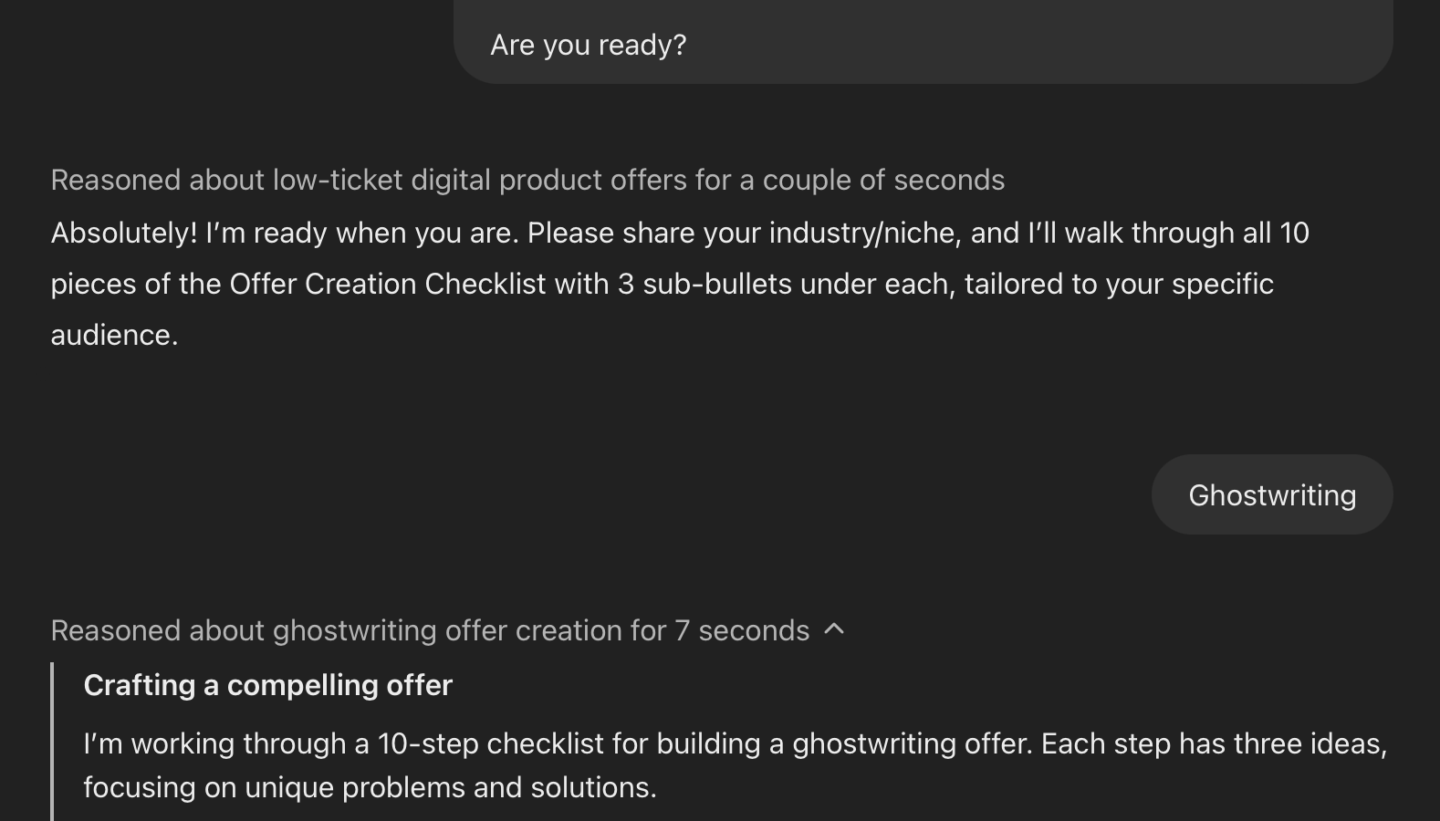
In general, here’s what this should look like—and all you have to do is give AI your topic/niche-within-niche:
Name Your Low-Ticket Product (Something Tangible!)
Now there’s two parts to your Offer:
The name of your Digital Product
And then how you speak to the benefits of your Digital Product (what problem it solves, who it’s for, what outcome it unlocks, etc.)
Let’s start with naming your low-ticket Digital Product something tangible, first.
Low-Ticket Product Naming Conventions
The million-dollar question: “WHAT SHOULD I NAME MY PRODUCT?!”
The short-answer is, as long as it’s tangible, it’s probably a good name.
But here are 20 naming conventions you can use to get the creative juices flowing:
[Number] for [Number]
Example: “Ship 30 for 30.”
Why It Works: We anchor the user to a specific quantity and a defined timeframe. Clear, immediate, and tangible outcome: “I’ll achieve X in Y days.”
[Topic/Skill] OS
Example: “LinkedOS.”
Why It Works: Positions your product as an “Operating System,” implying a structured, foundational system the user can install and run.
The [Adjective] [Blueprint/Playbook/Toolkit]
Example: “The Ultimate Ghostwriter’s Blueprint.”
Why It Works: “Blueprint,” “Playbook,” “Toolkit,” etc., all sound like physical artifacts. Adding an adjective (e.g., “Ultimate,” “Rapid,” “Essential”) emphasizes its completeness.
[Topic/Skill] in a Box
Example: “Podcasting in a Box.”
Why It Works: Conjures the image of an all-inclusive “kit” that contains everything you need to solve a specific problem.
The [Number]-Day [Challenge/Accelerator]
Example: “The 14-Day YouTube Accelerator.”
Why It Works: Creates built-in urgency, a definitive time commitment, and a sense of community involvement (“challenge”) or speed (“accelerator”).
The [Topic] Roadmap
Example: “The Ghostwriting Roadmap.”
Why It Works: “Roadmap” implies step-by-step direction, with tangible checkpoints along the way.
The [Topic] Toolkit
Example: “The Freelance Pricing Toolkit.”
Why It Works: “Toolkit” suggests practical, hands-on resources or templates a user can “pick up” and apply.
The [Topic] Vault
Example: “The Content Growth Vault.”
Why It Works: Suggests a hidden repository of resources, templates, or guides that feel exclusive and valuable.
The [Topic] Launch Pad
Example: “The Low-Ticket Launchpad.”
Why It Works: Communicates that your program will “launch” users toward a goal—quick momentum and a clear starting point.
[Number] Steps to [Outcome]
Example: “7 Steps to Your First $1,000 Ghostwriting Client.”
Why It Works: Highlights an exact pathway with a finite number of steps, making the product feel concise and doable.
The [Topic] Playbook
Example: “The LinkedIn Leads Playbook.”
Why It Works: “Playbook” indicates a strategic, tactical document—like a sports team’s key plays that can be followed for consistent results.
The [Topic] Bootcamp
Example: “The 30-Day Content Writing Bootcamp.”
Why It Works: Implies hands-on, rigorous training with tangible milestones—no fluff, just direct, action-focused learning.
The [Topic] Sprint
Example: “The Blog Launch Sprint.”
Why It Works: Connotes speed and intensity over a short period—perfect for someone who wants quick wins.
The [Topic] Command Center
Example: “The Social Media Command Center.”
Why It Works: A “command center” sounds like a centralized control hub, giving the impression of powerful oversight and organization.
The [Topic] Protocol
Example: “The Ghostwriting Client Acquisition Protocol.”
Why It Works: “Protocol” suggests a tested, formalized procedure, giving the product a sense of authority and rigor.
The [Topic] Lab
Example: “The Email Marketing Lab.”
Why It Works: Implies experimentation and discovery—users expect hands-on exercises, templates, and the freedom to test ideas.
The [Topic] Method
Example: “The 5-Figure Freelancer Method.”
Why It Works: “Method” implies a replicable system—highly useful for establishing credibility (e.g., “I have a method, not just random tips.”).
The [Topic] Starter Pack
Example: “The Instagram Growth Starter Pack.”
Why It Works: Positions your offer as a curated “starter kit” of resources, checklists, or tools for immediate set-up and quick wins.
The [Topic] Accelerator
Example: “The Ghostwriter Accelerator.”
Why It Works: Suggests rapid progress or fast-track success toward a specific outcome, with the connotation of leveling up quickly.
The [Topic] Workbook
Example: “The Content Repurposing Workbook.”
Why It Works: A “workbook” is inherently tangible—people envision step-by-step exercises, worksheets, and fill-in-the-blank templates they can literally (or digitally) write in.
Naming Your Low-Ticket Product with AI
And if you want to accelerate your low-ticket product naming brainstorming, you can use this AI prompt.
Just copy/paste this training prompt into ChatGPT/Claude and it will give you 20 different low-ticket product names.
*NOTE: BE SURE TO ADD IN YOUR NICHE/INDUSTRY IN THE FIRST SENTENCE OF THE PROMPT.
*Pro Tip: If you want to generate higher-quality digital product names, specify your niche/industry as well as the target customer AND the biggest problem you want to help them solve. (The more specific of inputs you provide AI, the higher-quality the output.)
You are an AI naming assistant. I have a list of 20 naming conventions I want you to use to come up with digital product name suggestions for the [YOUR NICHE/INDUSTRY] space.
The 20 naming conventions are:
[Number] for [Number]
[Topic/Skill] OS
The [Adjective] [Blueprint/Playbook/Toolkit]
[Topic/Skill] in a Box
The [Number]-Day [Challenge/Accelerator]
The [Topic] Roadmap
The [Topic] Toolkit
The [Topic] Vault
The [Topic] Launch Pad
[Number] Steps to [Outcome]
The [Topic] Playbook
The [Topic] Bootcamp
The [Topic] Sprint
The [Topic] Command Center
The [Topic] Protocol
The [Topic] Lab
The [Topic] Method
The [Topic] Starter Pack
The [Topic] Accelerator
The [Topic] Workbook
Instructions:
Replace “Topic/Skill” with something that is relevant and tangible within the [YOUR NICHE/INDUSTRY].
Replace “Adjective” with something powerful or descriptive (e.g., “Ultimate,” “Essential,” “Rapid”).
Replace “Outcome” with the specific result people want in the [YOUR NICHE/INDUSTRY].
Use [Number] or [Timeframe] values that seem compelling and relevant.
Please provide 20 unique digital product name suggestions, one per naming convention, in a clear, numbered list (1 to 20).
Thank you!
Offer 1-Liner/Subtitle
Once you have a Tangible name for your low-ticket digital product, it’s time to assemble your simple 1-liner—which you can also think about and refer to as the product’s “subtitle.”
Think of this as the short explanation and “elevator pitch” for your digital product—and what you will lead with on your landing page, in your marketing copy, emails, even social content CTAs.
Example #1: Low-Ticket Launchpad
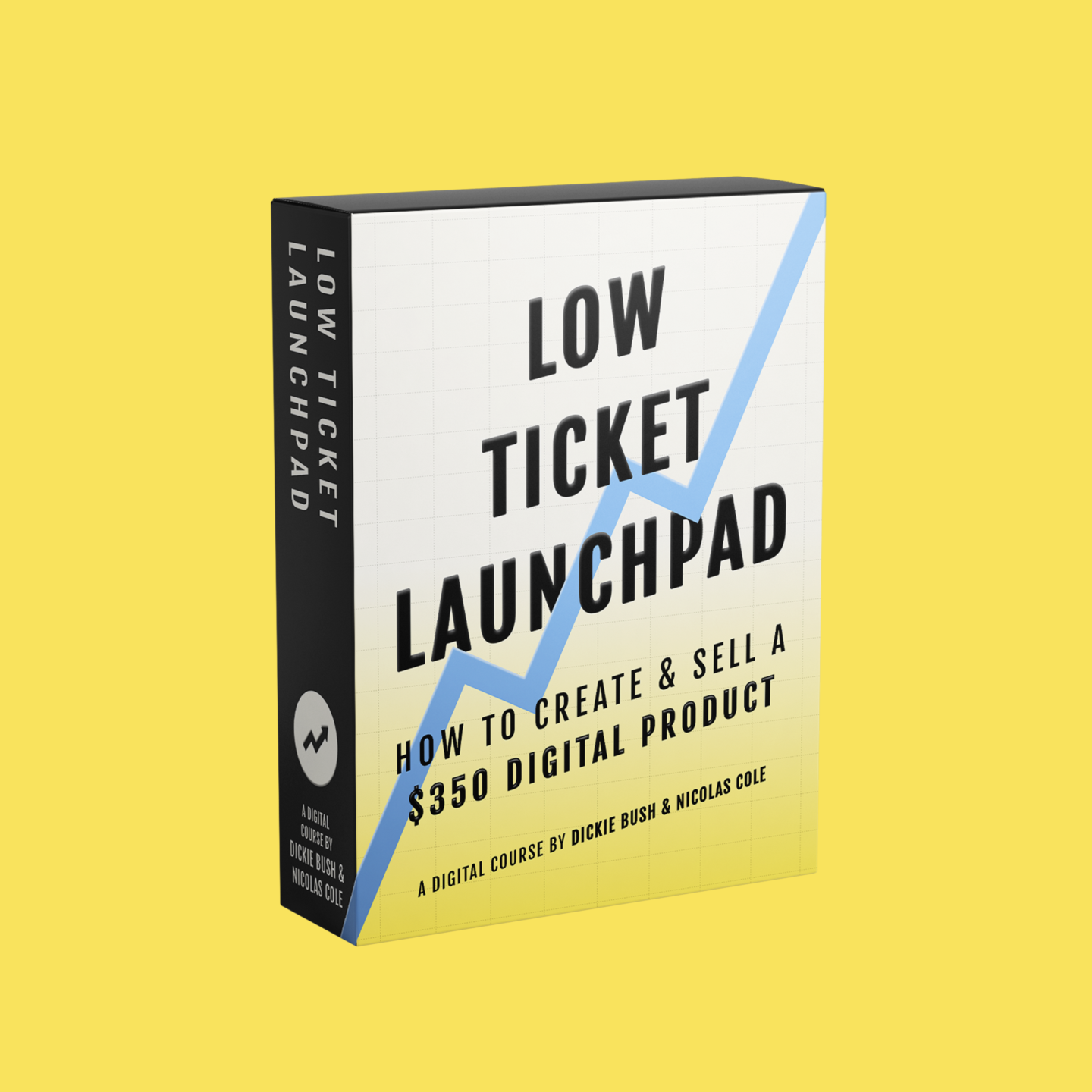
Example #2: Category Newsletter Creator
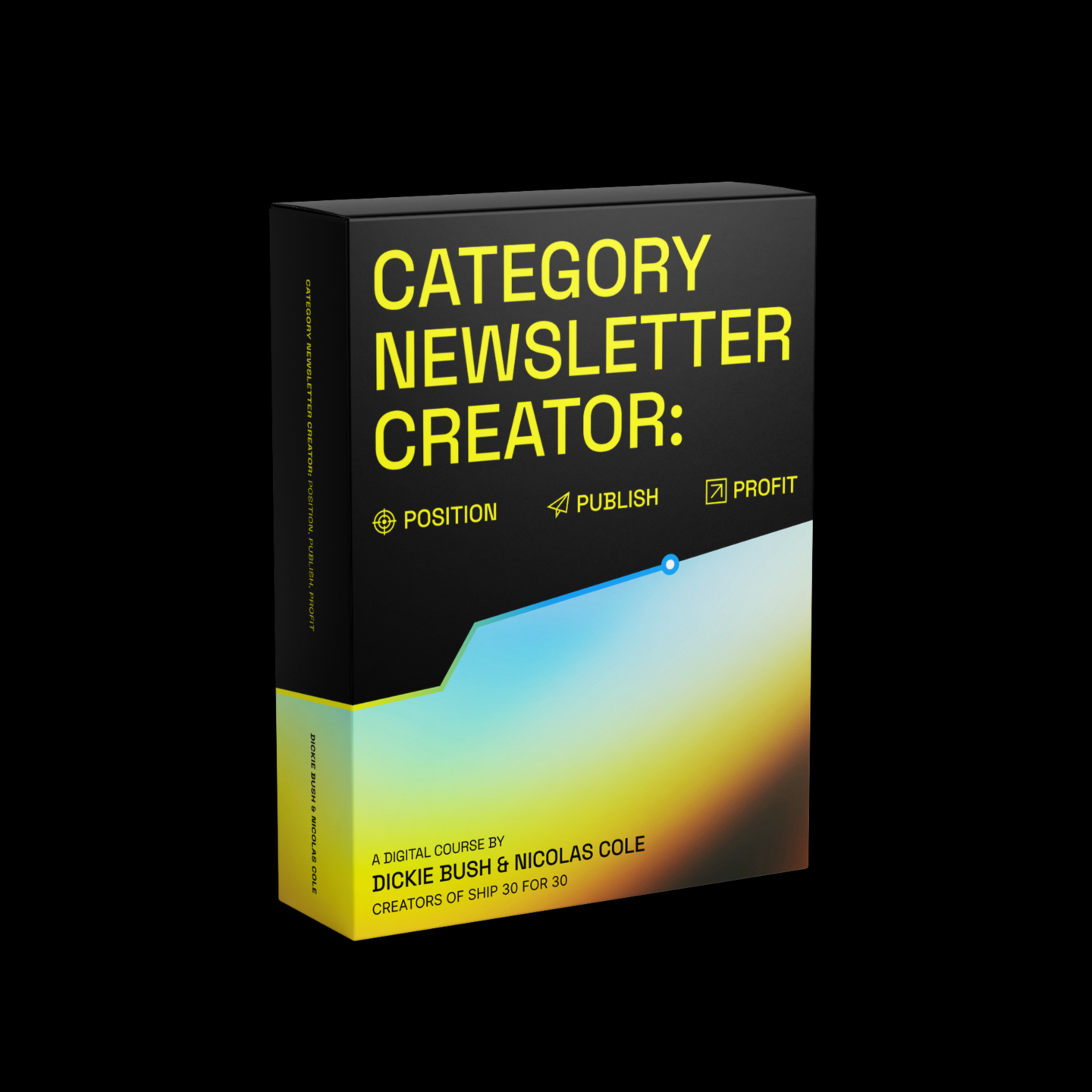
These are the pieces you will end up speaking to either further down the landing page and/or in your marketing emails, so we can ignore these for now:
✅ Price-Anchored To Upside 5x-10x What You’re Charging
✅ Or Price-Anchored to Downside 5x-10x What You’re Charging
✅ Positioned In A Niche Where You Have Experience
✅ And Proof It Works
Here are the pieces you should lead with in your 1-Liner:
✅ Specific Problem
✅ Solved For A Specific Person
✅ Solved In A Specific Way
✅ Achieving An Objective Outcome
✅ In A Specific Time Frame
✅ Named Something Tangible
I recommend using one of the following templates:
Template #1: {Problem Solved} And {Achieve Objective Outcome} in {A Specific Time Frame}
- Example: “Overcome your fear of writing online and publish your first 10 Tweets in 10 days”
Template #2: {Problem Solved or Achieving An Objective Outcome} By Doing {Specific Way}
- Example: “Build the ultimate productivity tracker and instantly reclaim 10 hours per week using The Excel Shortcut System”
Template #3: {Achieving An Objective Outcome} for {Specific Person}
- Example: “Build your first revenue-generating SaaS tool as a No-Code Developer”
Notice though, all we’re doing is mixing and matching different variables on our list.
You can combine them any way you’d like—but this should help you get started.
Use AI To Write Your Offer 1-Liner
If you need some help getting started, here’s an AI prompt you can use to generate a bunch of different 1-Liner options for your Offer—based on your low-ticket digital product’s name.
*NOTE: DON’T FORGET TO ADD YOUR NICHE/INDUSTRY & DIGITAL PRODUCT NAME TO THE TOP OF THE PROMPT.
You are an AI copywriting assistant. I am going to give you two pieces of information:
My niche/industry: [YOUR NICHE/INDUSTRY HERE]
My product’s tangible name: [YOUR PRODUCT NAME HERE]
Using the guidance below, please write 10 different 1-liner options for my low-ticket digital product offer. Each 1-liner should incorporate these key elements:
✅ Specific Problem
✅ Solved For A Specific Person
✅ Solved In A Specific Way
✅ Achieving An Objective Outcome
✅ In A Specific Time Frame
✅ Named Something Tangible (the product name)
You can mix and match these elements in any order, or use one (or combine more) of these 3 templates:
Template #1:
{Problem Solved} AND {Achieve Objective Outcome} in {A Specific Time Frame}
- Example: “Overcome your fear of writing online and publish your first 10 Tweets in 10 days.”
Template #2:
{Problem Solved or Achieving An Objective Outcome} BY DOING {Specific Way}
- Example: “Build the ultimate productivity tracker and instantly reclaim 10 hours per week using The Excel Shortcut System.”
Template #3:
{Achieving An Objective Outcome} FOR {Specific Person}
- Example: “Build your first revenue-generating SaaS tool as a No-Code Developer.”
Instructions
Reference my specific niche and audience as needed (e.g., ‘beginner ghostwriters,’ ‘busy freelancers,’ etc.).
Incorporate my tangible product name in each 1-liner to emphasize what they’re actually getting.
Vary your wording across all 10 options—each one should feel unique but still follow the main structure.
Now, please provide 10 concise and compelling 1-liner variations that showcase how my low-ticket digital product solves a specific problem, for a specific person, in a specific way, leading to an objective outcome within a certain timeframe, and referencing my product’s tangible name.
Module 3 Exercise
That’s it for Module 3 of Low-Ticket Product Creation!
You now know ALL the variables required in order to build an irresistible low-ticket digital product offer!
But, before you move on to the next module… I strongly encourage you to go through this exercise:
Module 3 Exercise
Take the Offer Creation Checklist and fill-in answers next to each variable:
✅ Specific Problem → What problem are you solving?
✅ Solved For A Specific Person → Who, specifically, are you going to help?
✅ Solved In A Specific Way → How, specifically, are you going to help them?
✅ Achieving An Objective Outcome → What objective, tangible outcome are you helping this specific person unlock?
✅ In A Specific Time Frame → Is there a time constraint you can use to create urgency, and can you deliver on that promise?
✅ Price-Anchored To Upside 5x-10x What You’re Charging → How much more time/money could this person have if they solved this problem in their life?
✅ Or Price-Anchored to Downside 5x-10x What You’re Charging → How much time/money could this person save if they solved this problem in their life?
✅ Named Something Tangible → Is your Digital Product named as an OBJECT, and not “an idea.”
✅ Positioned In A Niche Where You Have Experience → Is your product positioned in an industry/niche you’ve already been actively creating and writing within for a sustained period of time?
✅ And Proof It Works → Is this a problem you’ve successfully solved for yourself and/or helped a small number of other people solve in their lives as well?
You will use all of these pieces in your marketing materials later, so you might as well make these strategic decisions now.
But more importantly, these decisions actually dictate what kind of product you build—because you want the product to deliver on these promises!
(And I promise, if you try to do this at the very end, you’re going to realize you built the wrong product and have to start all over. So don’t do that.)
Key takeaways
TODO - For Ray