Module 1: All Your Faulty Beliefs
Welcome!
Hey there!
Welcome to Module 1 of Low-Ticket Product Creation, a mini-course inside of Low-Ticket Launchpad.
Right out the gate, we need to start with some tough love (because we really want you to be successful, and know you need to hear these things!).
The single biggest bottleneck to your ability to monetize and/or scale your digital income is not:
Your niche
Your pricing strategy
Your knowledge of funnels
Your marketing strategy
Etc.
Your single biggest bottleneck (and we watch people struggle with this every single day, at every single level of business) is…
YOUR FAULTY BELIEFS ABOUT MONEY & SELLING DIGITAL PRODUCTS!!!!!
Which is why we’re going to dismantle those, first.
Let’s dive in!
Faulty Belief #1: "I'm not ready."
I love this faulty belief, because it can easily be overcome with a simple question.
Whenever people say this to me, all I do is ask them back:
“Define ‘ready’ for me. At what objective milestone will you be ready?”
Is it when you’ve reached a certain number of followers? What’s the number? Exactly how many?
Is it when you’ve reached a certain number of email subscribers? What’s the number? Exactly how many?
Is it when you’ve had a certain post, or number of posts, cross a certain threshold of Likes, views, comments, etc.? What is that threshold? Define it.
The point is, whenever people hit me with this faulty belief, and I ask them to define the exact, objective, measurable moment when they will officially be “ready,” they can’t.
And of course they can’t.
Because a) it’s not real, they’re just afraid of taking action, and b) I promise, even if you pick an objective, measurable milestone, you’re just going to kick the can again when you get there.
The goalpost never stops moving.
Which means you will never “be ready.”
You become ready the moment you decide you’re ready—which should be TODAY.
Faulty Belief #2: "My audience isn't big enough"
Why?
Why would you want to wait?
Waiting just means you postpone the learning process.
Waiting just means you make less (or no) money now, but the same amount of money later.
And waiting just means you get better, faster, at other skills that aren’t “monetization”—so if that’s your goal, then you’re really just choosing to take the longer road.
This faulty belief also operates under the following assumptions:
That “when your audience is bigger,” you will launch a better product (not true—they’re completely different skills).
That “when your audience is bigger,” you will make more money (not true—you would have made more money had you started monetizing earlier).
That “when your audience is bigger,” you will build more good-will and earn more trust with your followers (not true—having something for sale gives you MORE credibility, and assuming it’s helpful, builds MORE trust with your audience, not less).
This is just another clever way for people to avoid taking action.
They tell themselves, “I’ll create a better product if I do it later.”
But that’s not true.
And if you focus on “audience growth,” then that’s the metric you’re going to optimize for—not money. Which means your audience size may get bigger and bigger, but your bank account won’t. And followers don’t pay the bills.
Forget followers & audience size.
You would way rather be making $10k/mo or $100k/mo with a few thousand followers/email subscribers, than have 100,000 email subscribers and be “afraid to pitch your list” making $0/mo.
(We’ve watched sooooooooo many creators, including really big ones with way bigger audiences than us, make this mistake. Don’t be one of them.)
Faulty Belief #3: "My niche is too small"
If your niche was in fact too small, too saturated, and had no purchasing power, IT WOULDN’T BE A NICHE IN THE FIRST PLACE.
The industry literally would not exist.
So this is not true.
The mere fact the niche exists is proof:
It isn’t “too small.”
It isn’t “too saturated.”
And customers have money.
You just haven’t yet figured out what’s valuable and urgent enough for them to feel excited to give their money to you.
A counter-example here (and an easy way to overcome this faulty belief) would be if I asked you:
“Do you think I, Nicolas Cole, can make money in your niche?”
Usually, when I ask this question in reverse, the person instantly flip-flops and says the complete opposite:
“Well yea, I think you could.”
“Well yea, because you have all sorts of credibility.”
“Well yea, because you have a bigger audience, you have more money, you have a team, you’ve been doing this for a long time, blah blah blah.”
The point is, if you think “I” or someone else can do it, then the belief you haven’t isn’t actually true.
You’re saying your niche is too small, too saturated, and nobody can afford your products or services. But then you flip-flop and say, “Oh but you could probably do it.”
So, which one is it?
Is the niche truly broken?
Or do you just have a skill deficiency?
(Hint: It’s always the latter.)
Faulty Belief #4: "I can't deliver a $350 product"
There are a lot of different reframes you can use to overcome this internal objection (which is what a “faulty belief” really is), but here’s the one I’ve always found most helpful:
The reframe is you aren’t selling a product. You’re sharing how you solved a painful problem, for yourself, with someone else—in exchange for money.
This is a really important nuance.
A lot of times, people think of creating digital products as a game of “creating something valuable.” But that’s sort of like sitting in a room, by yourself, staring at the wall, asking yourself to come up with a really great startup idea.
It never works.
A much easier place to start is by reflecting on the problems you’ve solved for yourself, in your own life or career:
Was there a really boring or monotonous task at work you figured out how to automate? That’s a digital product.
Was your middle-of-the-day workout routine really inefficient and ineffective, and did you come up with a better alternative? That’s a digital product.
Was a client of yours struggling with something, and you helped them come up with a solution? That’s a digital product.
The point is, you might not deliver $350 worth of value to someone if your starting place is “let me come up with a really great product idea.”
But you will absolutely deliver $350 worth of value if you simply:
Solve a problem for yourself.
Break “how you solved that problem for yourself” down into steps.
Give those steps to someone else who would benefit from solving a similar problem/unlocking a similar outcome.
The other reframe I want to pass along to you is it’s VERY easy to deliver on $350 worth of value.
Let me tell you how:
First, you solve a problem for yourself and then share that solution with other people—and charge $350.
Second, one of two things is going to happen: either a) they are going to be over-the-moon thankful (congrats! You built a great V1 of your digital product on the first try!), or b) they are going to have lingering questions and even… complaints!
Third, either way, the path forward is the same. Just because your V1 was “good” doesn’t mean it can’t be improved—so the next step is to make it better. But if for some reason customers don’t think it’s good, you simply say, “I really appreciate you being a beta-user of this product. Let me send you an off-boarding survey/let’s jump on a quick Zoom call, I want to hear everything that was confusing or not helpful. I’ll make a bunch of upgrades based directly on your feedback, and give you lifetime free access to the improved version.”
See?
Not hard.
People are so worried about their product not being good enough, or letting people down. But the truth is, “unhappy customers” are not only the minority… they’re also a GOOD thing.
They are the ones who tell you what to improve.
And it’s very easy to make them happy.
Take their feedback.
Make improvements.
Help them for free.
Give them free lifetime access to all your upgrades.
Faulty Belief #5: "I'm not an expert"
Remember when you were in 4th grade, starting to wonder what Middle School was going to be like?
Who did you want to hear from?
Your parents? They’re experts. They went through Middle School, and High School, and maybe even College and Grad School, etc. They know a TON!
Your teachers? They’re experts. They went through Middle School, and High School, and maybe even College and Grad School, etc., AND work in the education system. They know a TON!
Of course not. In fact, these were the LAST people you wanted to hear from.
Instead, you wanted to ask your best friend’s older sister who was in 6th grade—just two years older than you.
You wanted to hear from someone who had just entered Middle School, not someone who went to Middle School 30 years ago.
And you wanted to hear from someone relatable and “close to your age,” not someone who has gray hairs.
And contrary to popular belief, this same dynamic holds true for the rest of your life.
If you want to learn how to swim, you don’t need Michael Phelps to be your teacher. You just need someone who knows how to now-drown.
If you want to learn how to play the piano, you don’t need a concert pianist to be your teacher. You just need someone who knows a little bit more than you do.
And so whatever “thing” your target reader/customer needs help with, they don’t need the world’s most accomplished person in the entire world to help them.
They just need someone a few steps ahead of wherever they are.
Which can be you.
Faulty Belief #6: "Pitching will make me spammy"
This might be the biggest faulty belief of them all—and I promise, it’s not just beginners who struggle with this.
We see huge creators with MASSIVE opportunity struggle with this, too!
But after building and selling digital products for years now, and coming up on over $15,000,000 in lifetime sales, we now have tons of objective data that proves this faulty belief is wrong.
You can read the full post here, but after running 19 cohorts of Ship 30 for 30, and generating millions of dollars in revenue, we learned it takes, on average, upwards of 20 emails to convert someone from being a free newsletter subscriber into a paying customer.
20 emails!!!
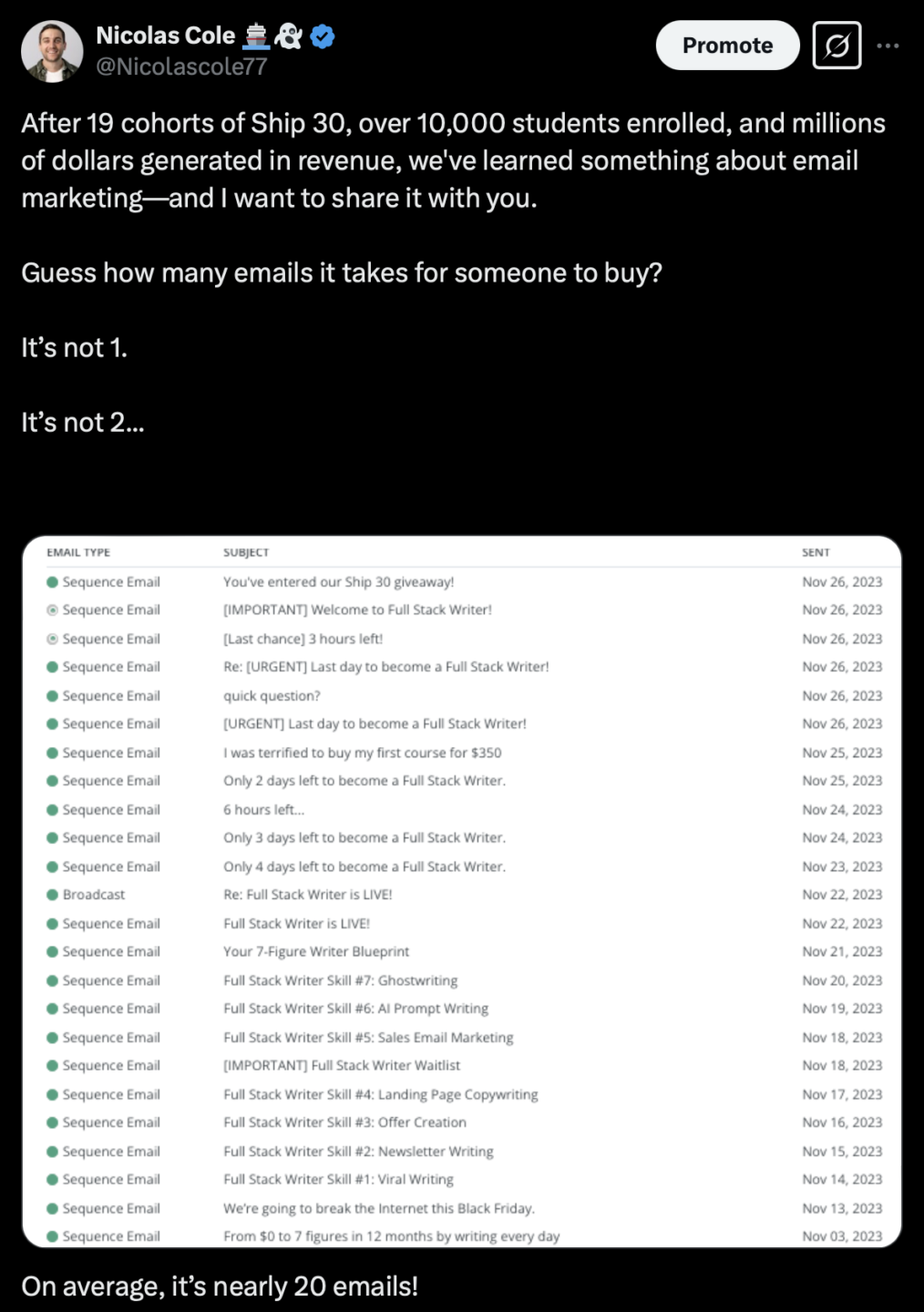
Pitching your list once isn’t sufficient.
And telling people “my product is live!” and then assuming sales are just going to roll in, forever, with no extra effort, is a mistake.
As a general rule of thumb when it comes to selling digital products: more emails = more money.
So believe whatever you want to believe, but we have years of data and millions of dollars of revenue that has proven to us, over and over again:
More emails = more money
Less emails = less money
Faulty Belief #7: "It must be perfect to sell"
Lastly, perfection is the enemy of progress.
There’s no such thing as the perfect product.
When we were building Ship 30 for 30 (and again, when we were building Premium Ghostwriting Academy), we overhauled the entire product every single cohort.
I can’t tell you how many times I:
Re-wrote the entire curriculum
Re-wrote all of our marketing sequences
Re-wrote all of our social content & CTAs
Re-wrote all of our live session presentation decks
Etc. etc. etc.
Millions and millions of words, written and re-written.
Now imagine if we had said, “We’re not going to launch Ship 30 for 30 until it’s perfect.”
First of all, it never would have happened. We never would have launched. We would have given up.
And second, we wouldn’t have known what to improve. The reason we re-wrote and re-built the product so many times was because, every cohort, we realized another 10+ upgrades we could make.
Even today, there’s an infinite amount of things we could do to make Ship 30 for 30 “better.”
But that doesn’t mean it’s not great as-it-is, and isn’t worth charging for. Of course it is.
There’s no such thing as a perfect product, which is why “perfect” shouldn’t be the goal.
Module 1 Exercise
That’s it for Module 1 of Low-Ticket Product Creation!
Again…
The single biggest bottleneck to your ability to monetize and/or scale your digital income is not:
Your niche
Your pricing strategy
Your knowledge of funnels
Your marketing strategy
Etc.
Your single biggest bottleneck (and we watch people struggle with this every single day, at every single level of business) is…
YOUR FAULTY BELIEFS ABOUT MONEY & SELLING DIGITAL PRODUCTS!!!!!
Which is why we had to dismantle those, first.
Now, here’s my recommendation…
Module 1 Exercise
Take 15-20 minutes and write out, verbatim, all the faulty beliefs that are still swirling around in your head:
Why can’t you start writing online, build an audience, and dominate a niche?
Why can’t you launch a low-ticket product, ASAP?
Why can’t you charge for your knowledge?
Why can’t you make millions of dollars on the Internet?
Whatever that little (evil) voice is saying in your head, I want you to write it down.
Put that voice on a piece of paper in front of you. See it outside of yourself.
Then, next to each faulty belief, write the reframe next to it:
“You don’t know what your niche is, and you can’t start until you figure that out.” → “There’s no such thing as the perfect niche. I just need to pick something and get going, and trust I can always change niches later.”
“You haven’t solved any valuable problems in your own life, so you can’t help other people do the same.” → “I know I’ve found solutions to valuable problems in my life, I’m just not aware of them yet—and I bet if I take some time to really think about it, I’ll come up with some great product ideas.”
“You can’t make millions of dollars on the Internet. Are you crazy?!” → “A lot of people way less capable than me have figured it out. There’s no reason why I can’t too.”
So much of making progress in life is about a) becoming aware of your own faulty beliefs, and then b) finding ways to reframe them to yourself.
Otherwise, I can give you all the hard skills and tell you all the answers (as I’m going to do here in this product), but none of it is going to matter if you can’t get out of your own way.
So, step 1… dismantle those faulty beliefs!
And trust that we’ve had to go through the same process.
If you had told us, at the very beginning, that our little “writing challenge” would go on to generate millions and millions of dollars, we would have laughed at you.
We didn’t believe it either!
But here we are:
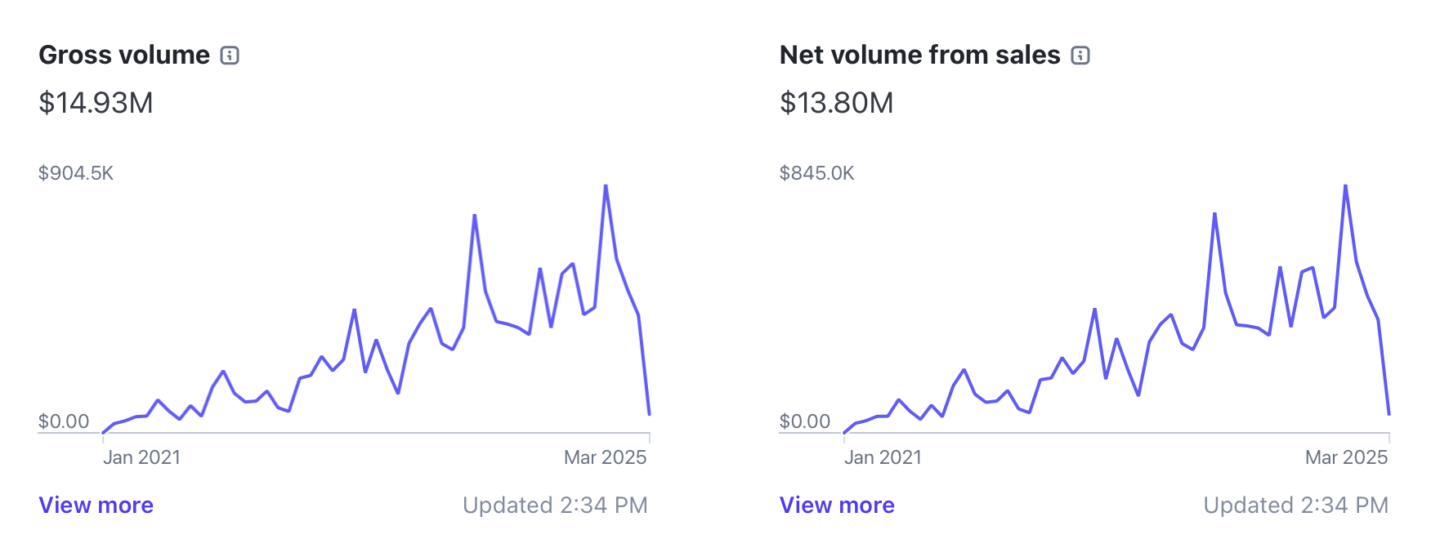
(Revenue chart resets each month. So no, revenue hasn’t fallen off a cliff and our business isn’t dead lol.)
Key takeaways
TODO: Fill in by Ray