Module 2: Million Dollar Funnel Overview
Welcome
Hey there!
Welcome to Module 2 of Low-Ticket Product Marketing & Monetization, a mini-course inside of Low-Ticket Launchpad.
Before we start giving you recommendations on the different types of software tools you should use (and why) to launch & sell your Low-Ticket Digital Product, I want to first give you a high-level overview of our Million-Dollar Funnel.
This is how we sell millions of dollars of low-ticket digital products each year.
In a nutshell, it goes like this:
Step 1: Drive Traffic
Step 2: Get free readers to opt-in to your email list
Step 3: Send free value to your email list each week, nudging them to the product landing page
Step 4: Collect payment
Step 5: Give customers access to your digital product
Walking through each of these steps will help you “visualize” how all these different pieces work together.
Then, we can talk about each individual component of our tech stack.
Let’s dive in!
Million-Dollar Funnel Overview
Building a million-dollar funnel is NOT as complicated as people think.
The challenge isn’t in setting it up.
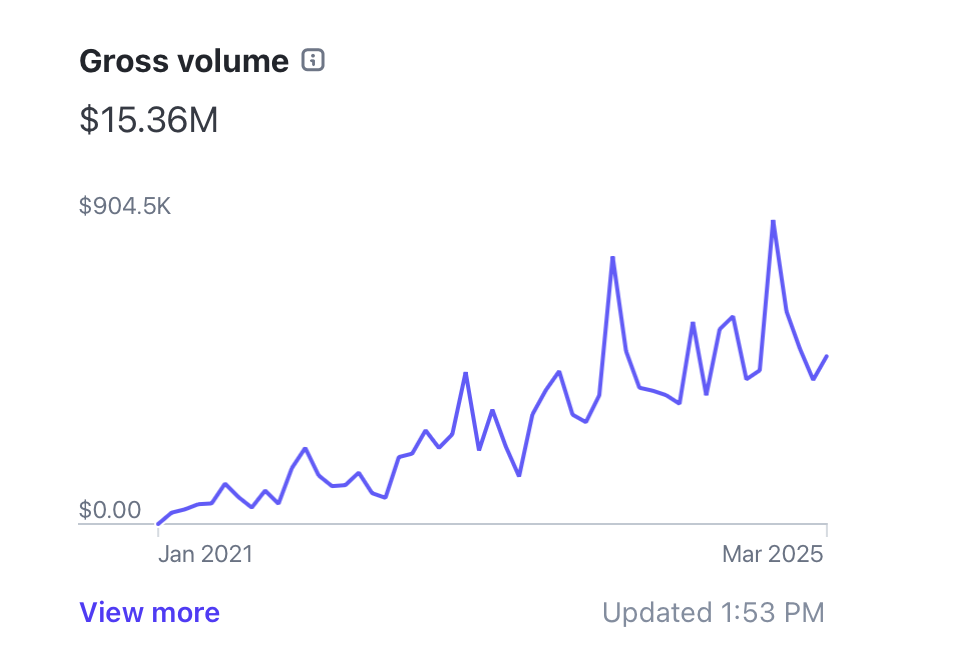
The challenge is, once it’s set up, being consistent long enough to see it start to work—and then making tiny tweaks and little adjustments over time, slowly but surely increasing all your core metrics:
Traffic
Opt-In Rate
Email Open Rate
Click-Through Rate
Purchase Rate
Again, all very easy skills to learn.
Most people just give up too early.
So, let’s walk through each step of our million-dollar funnel.
Step 1: Drive Traffic
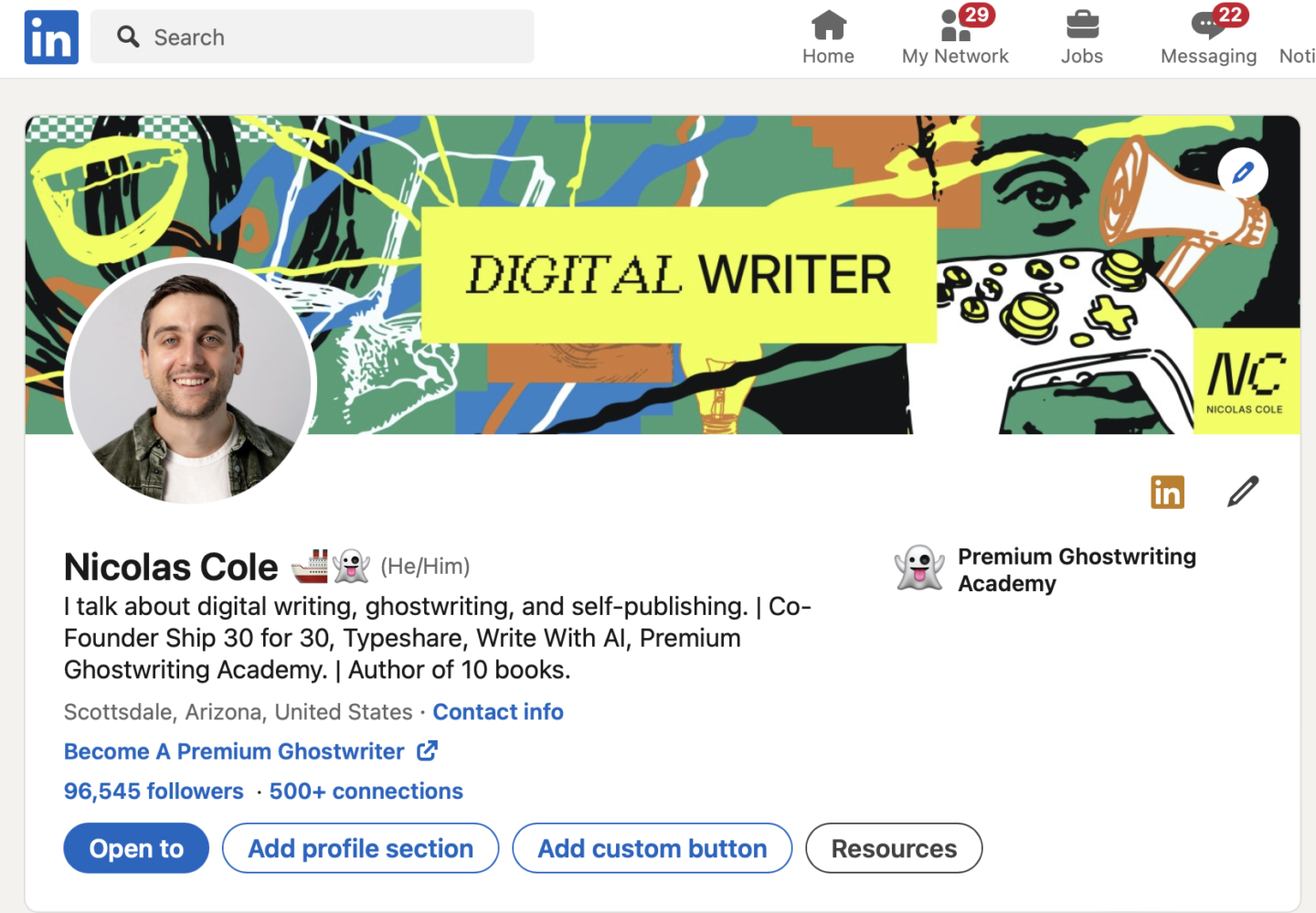
Now, quick crash course on “traffic.”
There’s really only 3 forms of traffic:
Cold Traffic: Ads, Affiliate Links, Outreach, Etc.
Warm Traffic: Organic Content, Inbound, Etc.
WOM Traffic: Word-of mouth (from previous, happy users/customers)
The truth is, you can drive traffic in all sorts of ways—but for the purposes of this training, I am going to talk exclusively about Warm Traffic in the form of Organic Content.
Why?
Because Organic Content is how we’ve sold millions of dollars of digital products (and I want to tell you what has worked specifically for us)
And because Organic Content is the easiest place to start. (Ads, for example, cost money and come with a much bigger learning curve.)
But there are all sorts of different ways you can drive traffic using Organic Content, too!
You can post on Instagram or Facebook
You can post on YouTube
You can post on X
You can post on Pinterest!
Again, the truth is… anywhere you can successfully drive traffic is great.
But here are my recommendations.
If you prefer creating text-based content, you should be creating content on:
X
LinkedIn
(And if you want to get fancy with it, I’d consider republishing content on Medium. But X & LinkedIn are the best text-based platforms right now by a wide margin. Medium is a fraction of the size and has considerably less distribution.)
And if you prefer creating video-based content, you should be creating content on:
Instagram
YouTube
“But Cole?! What about {{ Insert literally any other platform or opportunity }}.”
I’m sure there’s some version of this question rumbling around in your head right now.
And the answer is always the same:
I told you what the answer was.
And if you disagree, or want to try something else, go for it.
This is what marketing is all about.
You form a hypothesis… you go spend time, energy, and effort testing it… and if it works, you experience some sort of “win,” and if it doesn’t work, then you try again.
It’s that simple.
BUT, I want to emphasize that I (and “we” as a team) have tried and experimented with a LOT of different things.
And so, as far as platforms go, these are the recs:
X
LinkedIn
Instagram
YouTube
Now, what’s the PURPOSE of all this traffic?
It’s very simple.
Collect emails
Collect emails
Collect emails
Collect emails
Collect emails
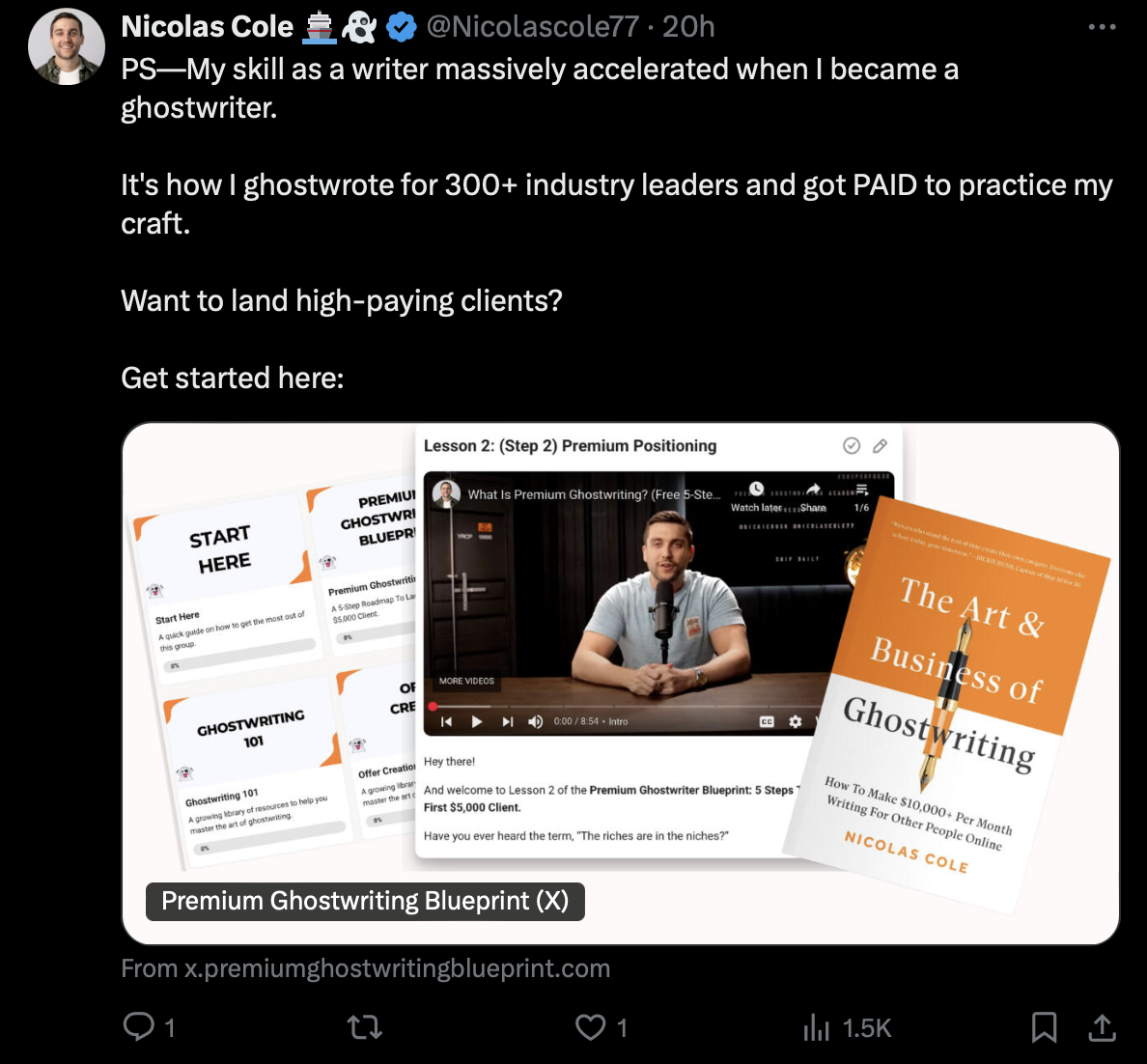
Creating content on social media with no CTA (”Call To Action”) to your email list (or some sort of email opt-in) is one of the biggest mistakes digital writers/creators make.
Is there value in “building an audience?” Sure.
But all the money, and how your digital product sells, happens via email.
So if you want a digital product that generates hundreds of thousands, even millions of dollars in revenue, then you HAVE to use Organic Content as a vehicle for getting people onto your email list.
This is the entire game.
“But Cole?! If I CTA over and over again to my email list, won’t I annoy my followers? Won’t people get mad at me? Won’t my entire life burn down King’s Landing at the end of Game of Thrones???????”
Sigh.
No.
This is 100% a faulty belief—and is just another clever way you’ve found to get in your own way.
Go look at what ANY big creator does. They link to their email list and/or email opt-in over and over again.
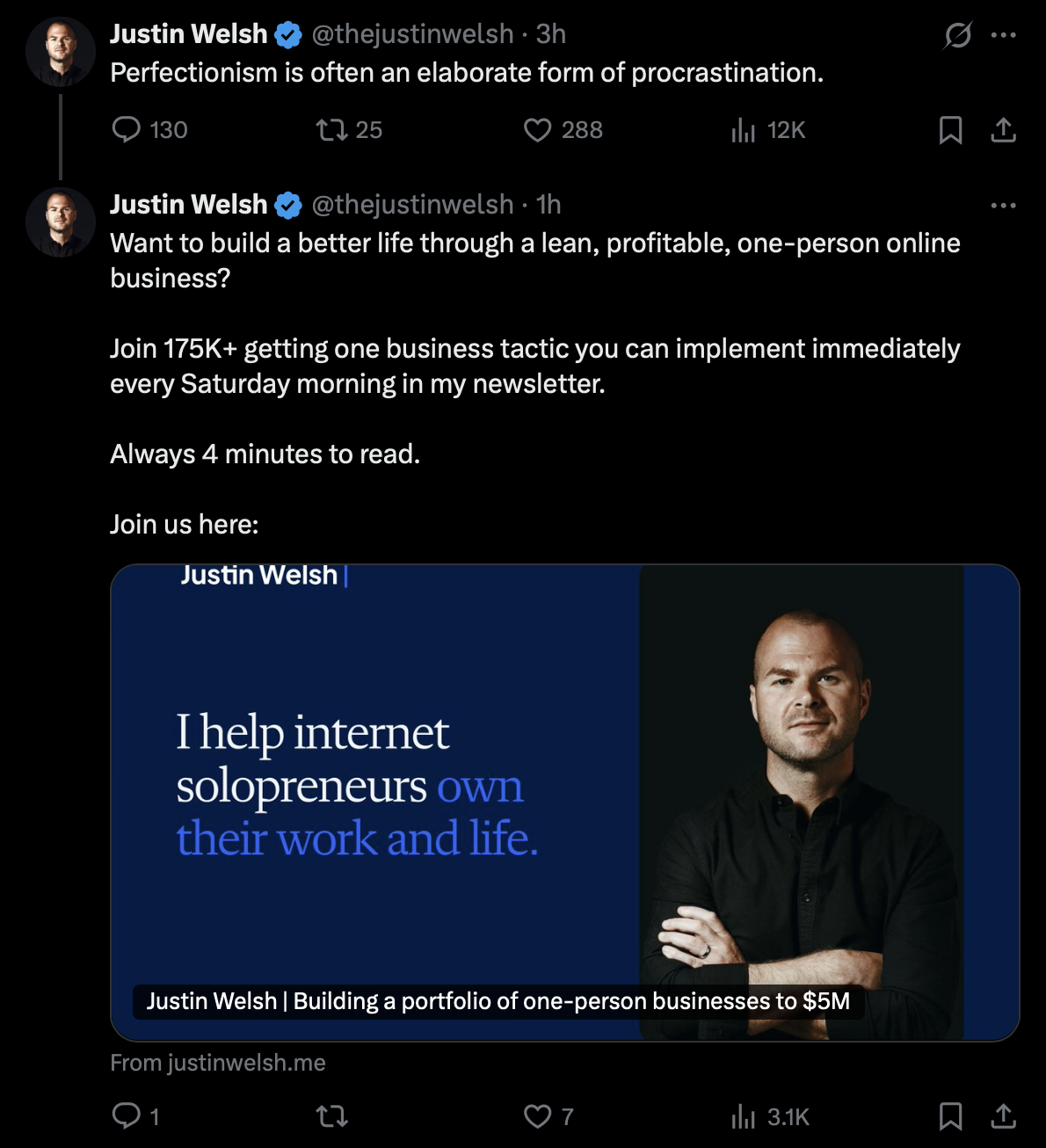
So, to recap… this is our super-advanced top-of-funnel system:
Write & create Organic Content
In a niche
And CTA to your email list/opt-in
It’s so simple!
And you just do this over and over again, for weeks and months and years.
Step 2: Opt-In
The whole goal is to drive free readers on social platforms over to your email list.
Why?
Because email is an “owned” platform—you own your email list—and you have significantly more control over how you interact with those people (whereas you have almost no control over who sees your posts on social platforms, and are victim to the algorithm).
Now there are 2 types of email opt-ins I would encourage you to use…
Beginner Option: Traffic to Newsletter
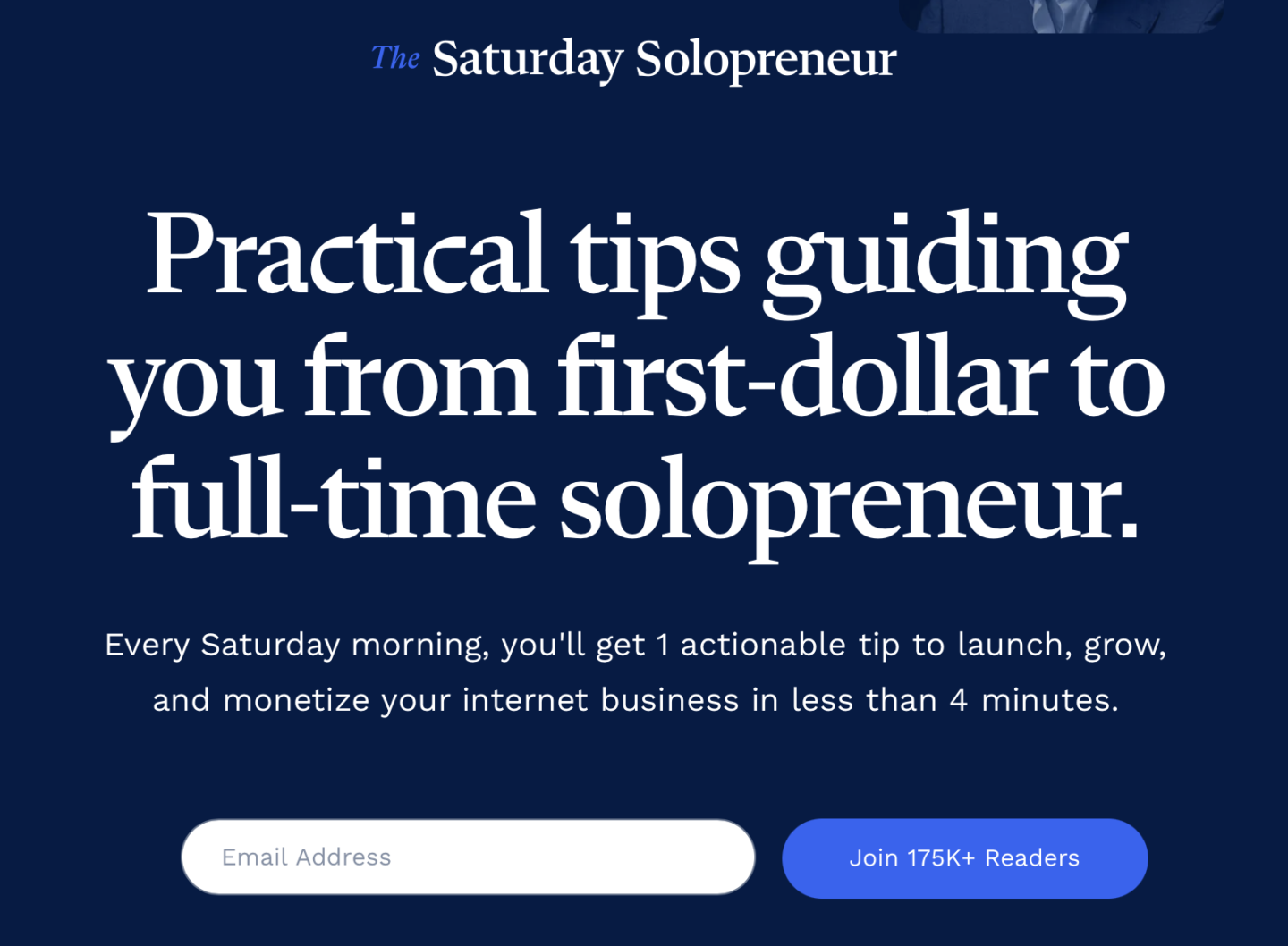
If you are brand new to the world of digital writing & creating digital products, then there’s no need to get fancy with it.
All you need to do is send readers to your newsletter—which can be easily hosted on a newsletter landing page.
Since “newsletters” are an entirely different rabbit hole, I won’t be covering them in-depth here. However, if you would like a detailed walkthrough of how to set this up, I’d encourage you to check out our Category Newsletter Creator product—which is entirely focused on newsletters & email marketing.
Advanced Option: Traffic to Educational Email Course
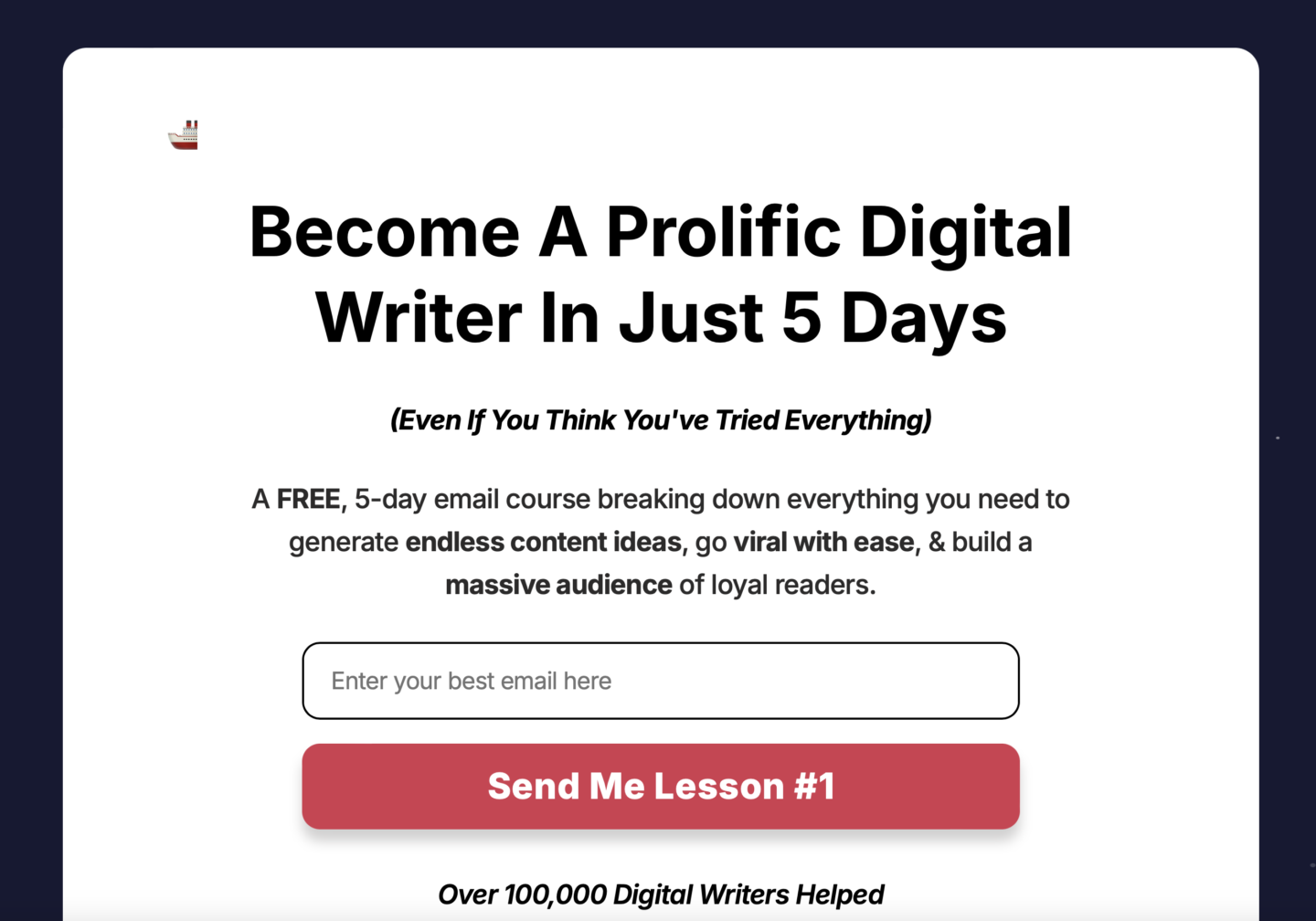
When we were first starting out, we just sent traffic to our newsletter landing page.
(And for what it’s worth: this worked fine, and is how we generated our first $1,000,000 selling Ship 30 for 30 + various digital products.)
But over time, we realized that if we could increase the conversion rate % of our email opt-in landing page, we would get significantly more people:
Onto our email list…
Which meant more potential buyers…
Which meant more revenue…!
So, we eventually created a more valuable email opt-in—in the form of an Educational Email Course—prompting people to type in their email in exchange for more “immediate” free value.
And then once they completed this 5-Day Educational Email Course, we would move them onto our weekly evergreen newsletter.
We now have opt-ins like this built for all of our different business segments:
If you don’t want to build an EEC (Educational Email Course), you can also increase the email opt-in rate by offering:
A free digital download
An Ultimate Guide
An Industry Report
A Template Pack
Etc.
But again…
For beginners, I recommend just driving traffic to a weekly newsletter landing page.
You can always upgrade to a stand-alone opt-in later if you want.
Step 3: Weekly Email Nurture
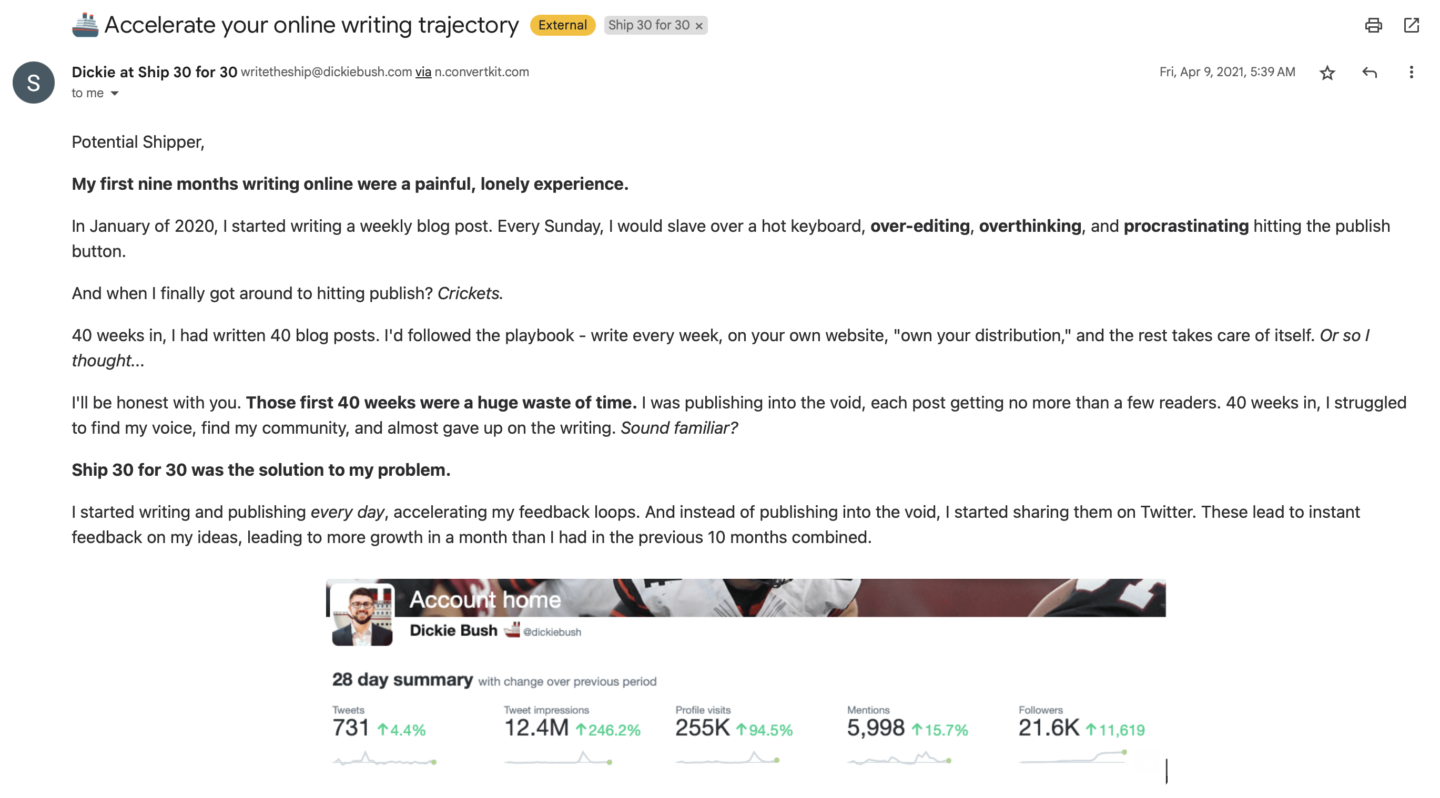
Once you get someone on your email list, the real game begins.
One of the biggest misunderstandings in the world of “digital products” is that people think you sell products via social platforms.
And that’s not true.
You use social platforms to drive TRAFFIC, and get people onto your email list.
But you sell products via EMAIL.
For example, we did an internal audit in 2024 looking at how many emails we had to send (on average) to get someone to buy Ship 30 for 30 and/or one of our digital products.
And it’s way more emails than you think.
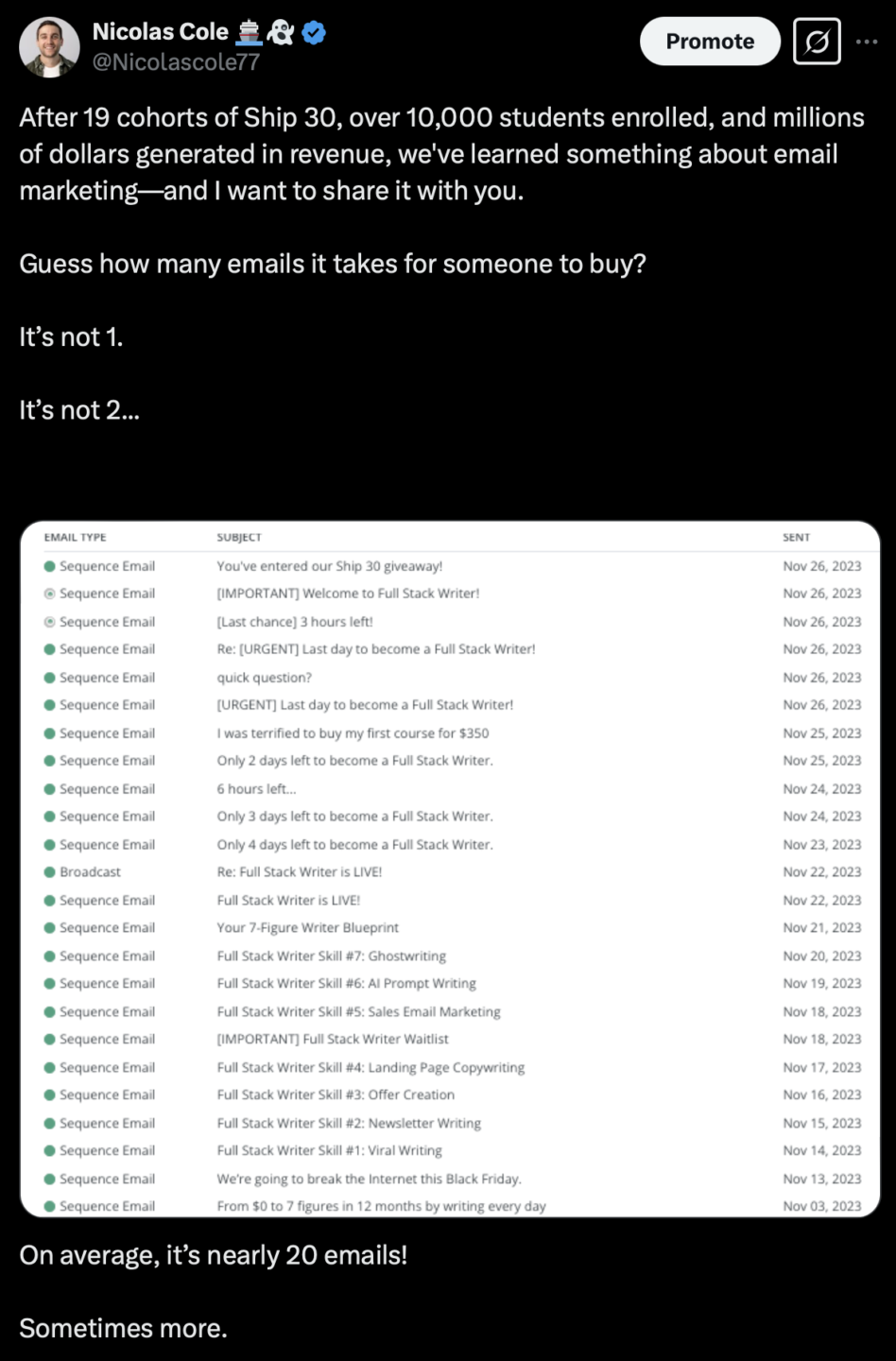
Whenever I am chatting with other digital writers/creators and/or auditing their funnels, ALMOST ALWAYS their biggest issue is they just aren’t sending enough emails.
They stopped sending their weekly newsletter.
They’re afraid to send more than 2 emails in a week.
And they have a faulty belief thinking they can’t “pitch their list” more than once, ever.
And all of these are wrong.
We now have a saying internally that goes like this:
The more emails you send, the more money you make.
And all of the data tells us this is true.
So, what should your “email” cadence be?
If you’re a beginner, just focus on sending 1 free-value email per week.
800-1,500 words
“More” & more in-depth on topics performing well on social (in your niche)
We like to send ours on Mondays (but day & time is pretty irrelevant when you’re starting out—just PUBLISH IT)
The challenge here is NOT “writing the perfect email.”
The challenge is always in building the discipline to stay consistent.
(For context: We have sent 1 free-value email to our Start Writing Online email list every single week for 4 years in a row. We’ve never missed a week. That might sound like a lot of work, but that email list is how we’ve generated millions of dollars in revenue. So, work aside, this is what’s required.)
If you’re more advanced and/or a seasoned marketer, you can add in a 2nd email per week.
This email doesn’t get sent to your entire list—it only gets sent to people on your email list who “clicked” on a link to your product’s landing page but DID NOT BUY. (We call this people “Clickers.”)
This email is NOT free value.
This email is 100% intended to answer the “Clickers’” questions, overcome their objections, and show them more social proof.
For example, here’s an email we sent to “Clickers” on our Premium Ghostwriting Academy email list—people who had clicked on our application and/or call-booking page, but didn’t end up booking a call.
We want to remind them, again, that they should!
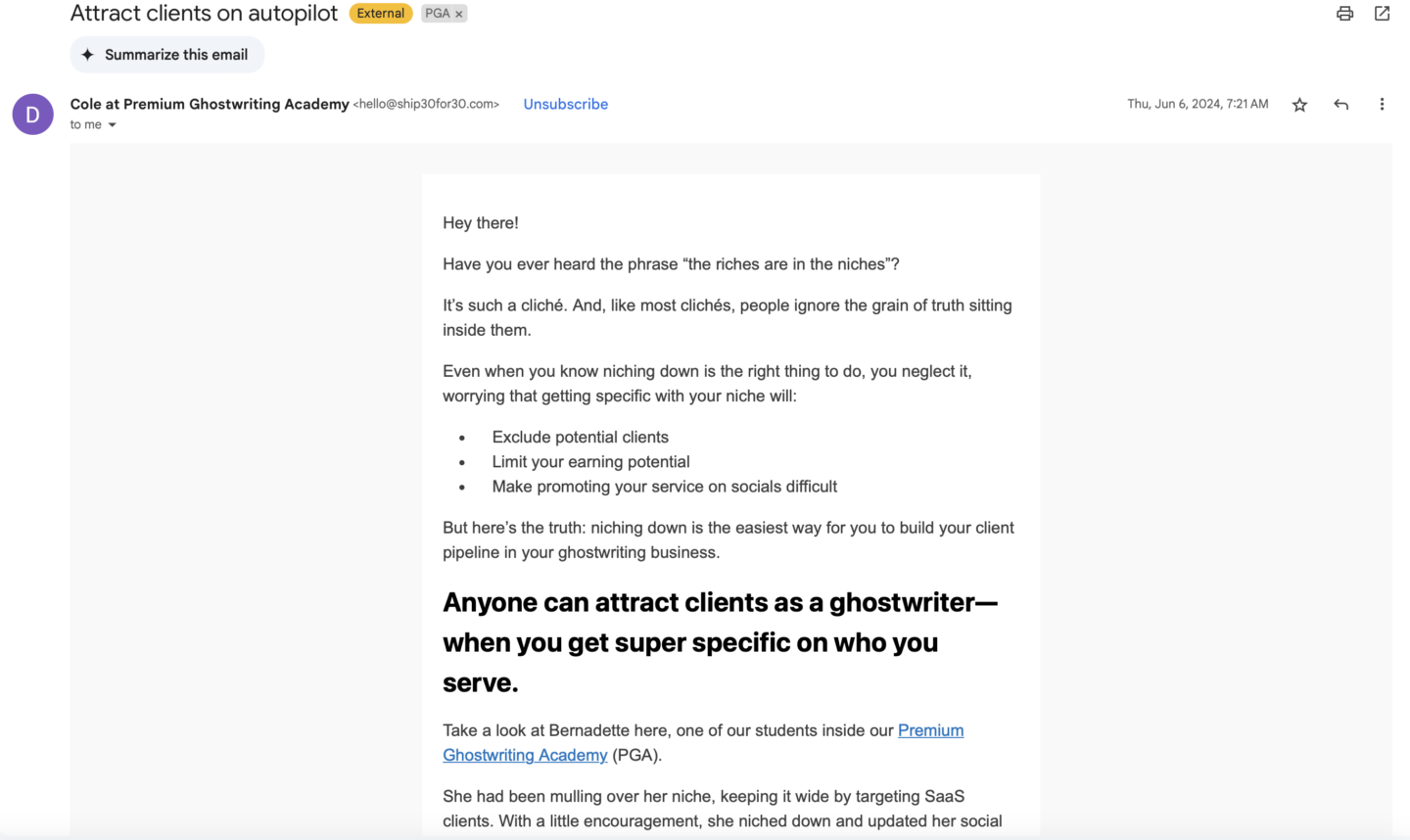
This email for “Clickers” is very simple, and only has 3 parts:
The question (aka: the objection) the person has to taking the next step
The answer (aka: the reframe of the objection) to help the person overcome that faulty belief within themselves
Some proof (a testimonial of some kind) showing how someone else, just like them, had the same question (aka: objection) and how they overcame it
And yes, we send some version of this email to all “Clickers” 1x per week.
So our email cadence looks like this:
Monday: Free-Value email to entire list
Thursday: Objection Handling email to “Clickers” list
And we do this every week, over and over and over again.
BUT… what’s the point of sending all these emails?
To drive clicks to your product landing page!!!
Step 4: Collect Payment
Your “landing page” is the page where your Low-Ticket Digital Product is hosted.
For example, here’s the landing page to our $350 Full-Stack Writer digital product.
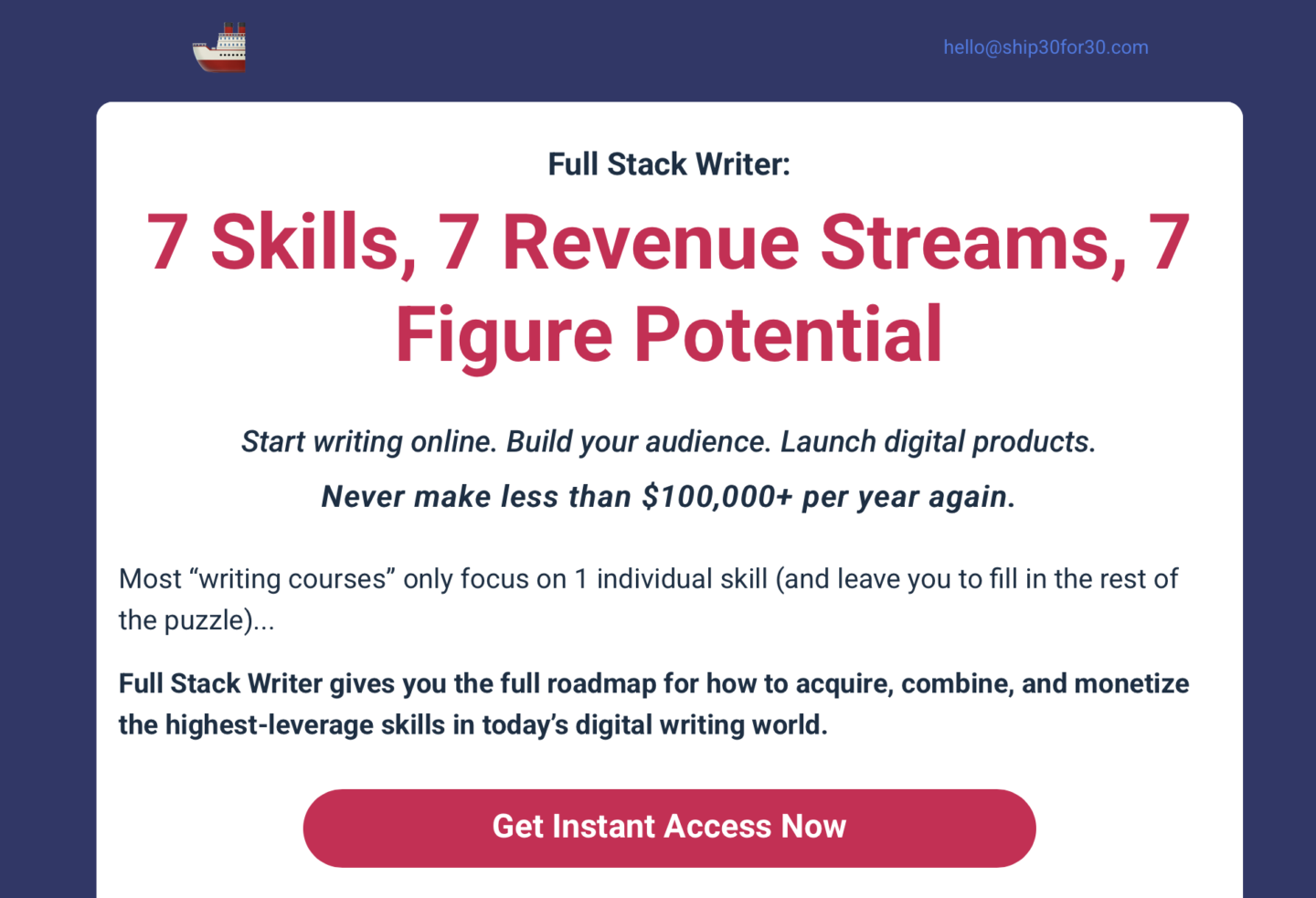
I’m going to cover all the in-depth nuances of building a high-converting landing pages in another module.
But here, the big idea you need to understand is that your landing page is what “sells” people on your Low-Ticket Digital Product.
And at the bottom, you collect payment for access to the digital product.
Once you have this product landing page live, and your product for sale, now you have a complete “funnel” allowing you to start capturing metrics & measuring funnel performance.
You can get REALLY nitty-gritty here, but high-level these are the Big 5 metrics that matter most:
Traffic: Organic Content Impressions
Email Opt-In: Newsletter/Opt-In Conversion Rate %
Email CTR: Clickthrough Rate To Product Landing Page (Inside Emails)
Product Landing Page Visitors: # of People Who Visit Product Landing Page
Product Purchases: # of People Who Complete Purchase
Because with these 5 metrics, you can start to measure success AND see which “piece” is the bottleneck to continued growth.
Step 5: Unlock Digital Product
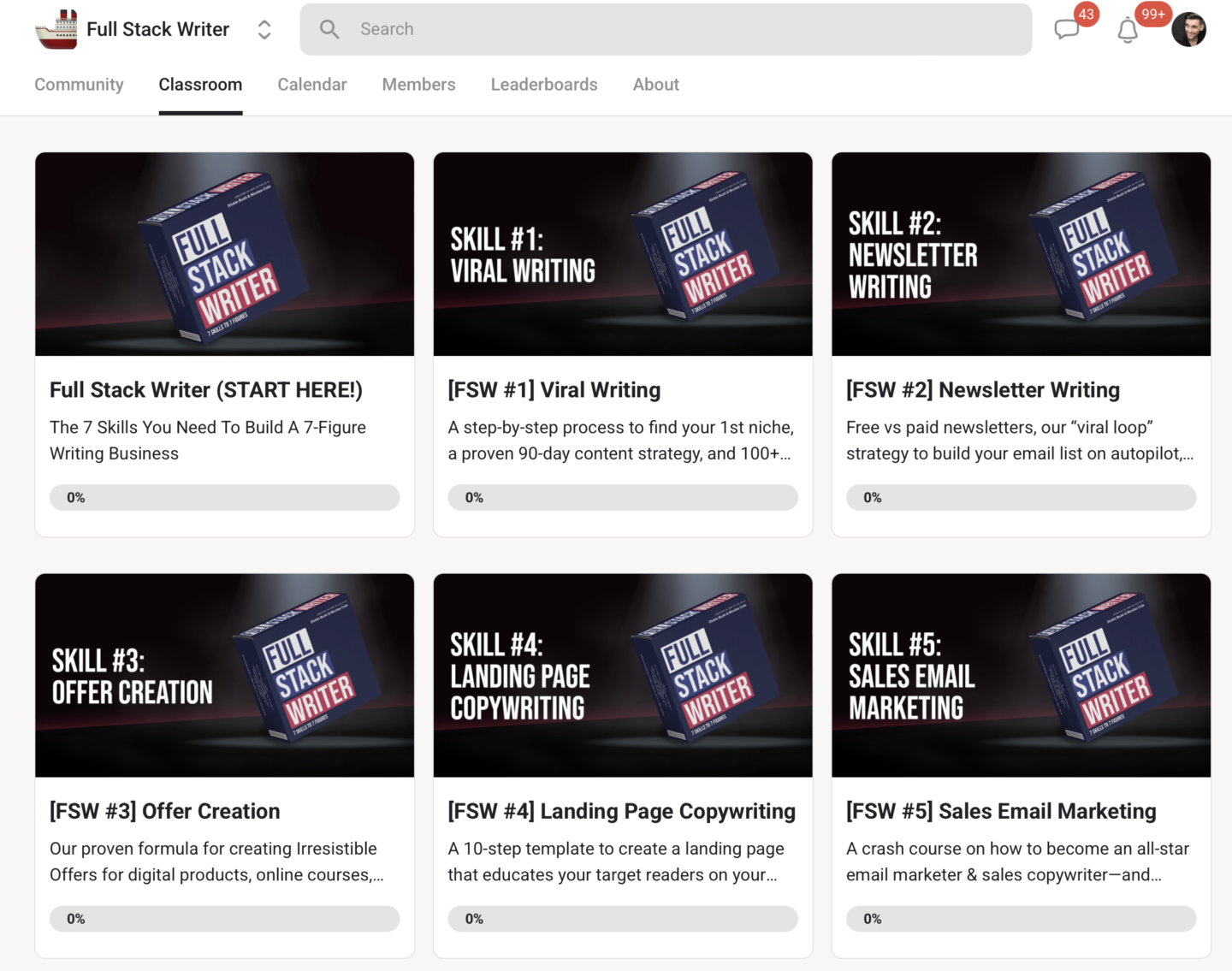
The last step, of course, is once someone purchases your Low-Ticket Digital Product… you have to give them access!
We’re going to walk you through all the nuances of setting up your post-purchase flow in our next module (Tech Stack).
In the meantime, let’s break it down from a high-level.
First off, here’s a quick flowchart so it’s easier for you to visually see all the moving pieces:
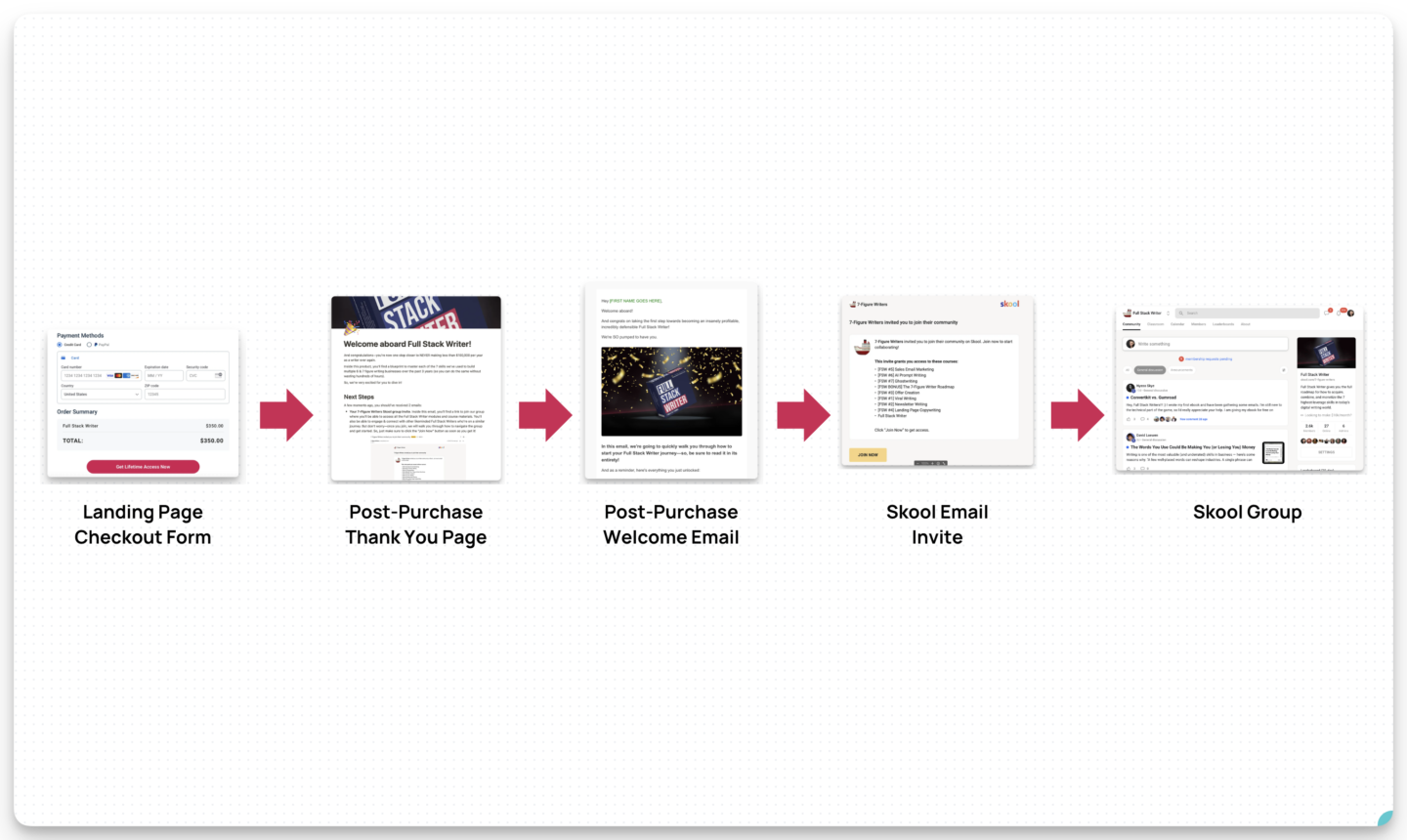
(Highly recommend double-clicking on the image so you can take a closer look!)
As you can see in the flowchart, there’s 5 different “pieces” involved here:
Your checkout form (which is located at the bottom of your landing page)
Your Post-Purchase Thank You Page
Your Post-Purchase Welcome Email
Your automated Skool Email Invite
Your Skool Group (which is where the content of your Low-Ticket Product is hosted)
Now, let’s break down how this post-purchase flow works (from the perspective of the customer):
When someone successfully buys your product, they’re going to be immediately redirected to a simple Thank You page.
Then, on this page, you’ll tell them to go check their inbox so they can find your Post-Purchase Welcome Email along with your Skool Email Invite.
From there, when they check their inbox they’ll have 2 emails:
Your Post-Purchase Welcome Email, where you’ll walk them through all the micro-steps they need to complete to get access to the product and start working through it (including looking for this next email).
Your Skool Email Invite. This is a simple, automated email that contains a link for them to “unlock” access to all your Low-Ticket Digital Product resources inside Skool.
Finally, after they click on the link inside your Skool Email Invite, they’ll gain access to your product and will be able to dig into all the resources you’ve put in there for them.
We’ve carefully designed this flow to make it as easy and frictionless as possible for people to get access to the product after they buy it.
But don’t worry—as I we said, we’ll show you how to set up all the different systems we use to automate all of this in the next module.
Module 2 Exercise
That’s it for Module 2 of Low-Ticket Product Marketing & Monetization, a mini-course inside of Low-Ticket Launchpad.
Now, if you want to see how our Million-Dollar Funnels work in-action, I’d encourage you to go through them yourself! (This is called “funnel hacking,” where you type in your email and observe what happens through the lens of a marketer.)
These are the opt-ins we’ve created for our different business verticals:
And if you want to funnel-hack some other big creators, I’d encourage you to subscribe to their newsletters and pay attention to their Welcome Email(s), their weekly newsletters, and any product promotion emails they send you—because this will show/teach you how different people execute this playbook!
Have fun funnel-hacking!
Key takeaways
TODO - For Ray