Module 1: Pricing Mastery
Welcome
Hey there!
Welcome to Module 1 of Low-Ticket Product Marketing & Monetization Mastery, a mini-course inside of Low-Ticket Launchpad.
Everything that follows operates under the assumption that you already have:
Clarified your Low-Ticket Digital Product Idea
Outlined the curriculum of your Low-Ticket Digital Product
And created all the modules of your Low-Ticket Digital Product
Which means… you’re now ready to price it, sell it, and market it!
So, to kick things off, in this module we’re going to start with pricing:
A crash course on business models for monetizing your knowledge
The different pricing tiers for “courses”
And how much you should charge for your Low-Ticket Digital Product (and why)
Let’s dive in!
Digital Business Models: Crash Course
Broadly speaking, there are 3 types of monetization models in the digital world of information/education:
Recurring: A micro-service and/or ongoing information & unlockable assets.
Stand-Alone: A single asset that solves a specific problem for a specific person (with no additional feedback or interaction).
Experiential: A series of assets combined with some form of community, accountability, coaching, etc.
It should be obvious which of these categories a Low-Ticket Digital Product would fall into.
A Stand-Alone Asset!
Benefits Of Low-Ticket Digital Products
Now, why do we recommend starting your monetization journey by selling a Stand-Alone Asset?
For a bunch of different reasons.
Most people begin monetizing with a (faulty) belief that the “cheaper” something is, the easier it will be to sell and the more people who will buy it.
And both of these assumptions are wrong.
Flaws with Recurring: On the “Recurring” business model side, everyone wants recurring revenue until they realize it takes recurring work. And the truth is, recurring products/micro-services (SaaS) take SIGNIFICANTLY more work than selling a Stand-Alone $350 Digital Product. They take up more time. They come with very high customer expectations (people want interaction—usually with you). And most of all, they are much harder to execute than people realize.
Flaws with Experiential: On the other side of the spectrum, “Experiential” has many (if not all) of the same flaws as Recurring, except with much more operational complexity. Think of “Experiential” as a more advanced business model.
To help you understand the nuances of these 3 different monetization models, here are some examples of each.
Model 1: Recurring
This could be…
A paid newsletter
A monthly asynchronous membership community (Skool, Patreon, etc.)
A monthly synchronous membership real-time chat channel (Telegram, Discord, etc.)
A SaaS platform
Etc.
In short, it’s anything that trades ongoing information (whether that’s in the form of assets or access to you) for ongoing payment.
And the vast majority of the time, all of these different business models fall in the $9/mo-$99/mo range.
Model 2: Stand-Alone
This could be…
An eBook or Book
A text & video course
An Ultimate Guide
A paid Educational Email Course
A template pack
Etc.
In short, it’s anything that trades information in the form of an asset in exchange for a one-time payment.
Notice how this is different than something that is recurring.
The vast majority of the time, all these different Stand-Alone assets fall in the range of $9-$350.
(For eBooks, books, ultimate guides, template packs, etc., you’re probably going to be in the $9-$49 range, whereas for more in-depth assets like a Digital Product/text & video course, paid Educational Email Course, etc., you’re probably going to be in the $99-$350 range.)
Model 3: Experiential
This could be…
A cohort-based course
A live paid webinar
A live paid event
A “coaching sprint”
A group-coaching program
A mastermind
Etc.
In short, it’s anything that trades information in the form of an asset in exchange for a one-time payment, but ALSO comes with some sort of experiential factor:
Accountability
Community
Coaching
Mentorship
Etc.
The vast majority of the time, these Experiential products fall in the $350 - $10,000 range.
And the reason there is such a wide pricing range here is because there are such varying degrees of how to “value the value” of the experience you’re providing.
For example, should a mastermind for small creators with less than 5,000 followers looking to make their first dollar on the Internet be priced the same as a mastermind for CEOs of startups valued at $30M and above—just because they’re both “masterminds?”
Of course not.
The experience, how much you’re promising and who your target customer is, greatly affects the price point.
“But Cole?! What if I want to do ALL these things?! What if I want to sell a Low-Ticket Product but also build a community, etc.?”
Don’t.
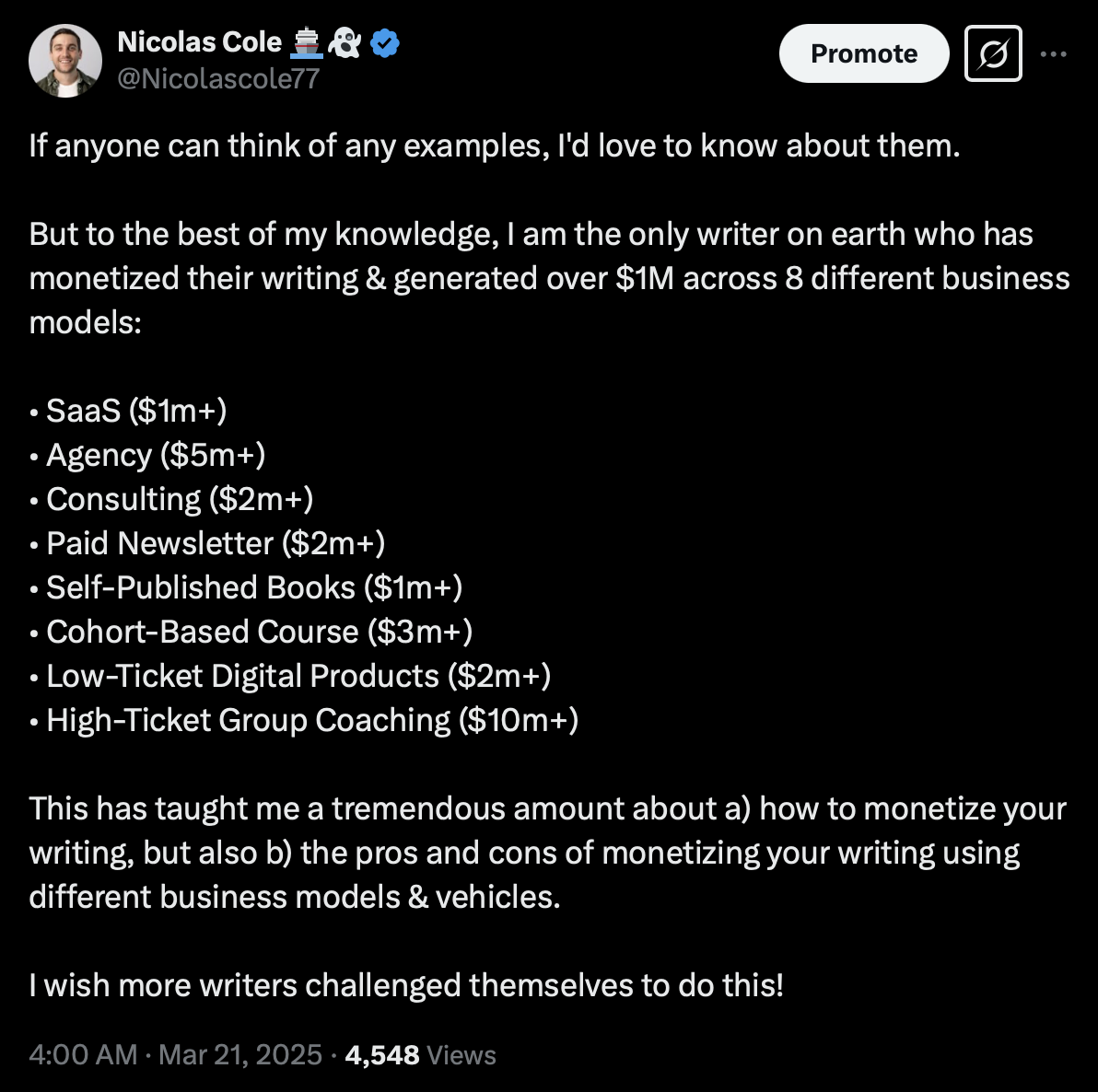
Most people who generate millions of dollars with their business do it by using 1 or maybe 2 different business models.
We have successfully done it using 8.
And I’m telling you, each one is different—and each one comes with an entirely new learning curve.
One of the biggest lessons that took me the longest to learn was how “hard” building a recurring product really is—regardless of whether that’s a paid newsletter or an ongoing community/membership.
And eventually, I realized… if you can’t successfully sell a Stand-Alone product, you’re never going to successfully build a recurring product.
Because a recurring product is really just an ongoing version of a stand-alone product.
Which is why I STRONGLY encourage you (and everyone else) to start monetizing with Low-Ticket, Stand-Alone Digital Products first.
This is the fastest way to get started monetizing in the form of digital assets
This is the easiest, and lowest “time suck” way to monetize
And it will allow you to build all the skills to eventually graduate & move on to other business models, later.
3 Pricing Tiers for "Low-Ticket Digital Products"
So, you agree… the best place to start is to first get really good at building & selling Low-Ticket Digital Products.
Great! (I knew you were smart.)
Which means now we need to talk about the different pricing tiers for Low-Ticket Digital Products.
Tier #1: Single Asset / Template ($9-99)
Think of this first tier as a micro-product.
It’s usually a single asset that your target customer in your niche would still find valuable, but not necessarily need an entire multi-module text & video course explaining.
For example, this could be:
An eBook or print book
A stand-alone ultimate guide
A swipe file (curated examples + breakdowns/explanations)
A paid Educational Email Course
A really valuable template
A template pack
Etc.
As a general rule of thumb, the smaller the asset the lower the price.
And the larger/more in-depth or advanced the asset, the higher the price—up to the $99 ceiling.
(For these types of assets, you’ll find there’s a bit of a pricing ceiling around ~$99. Some big creators can get away with charging more, but generally speaking this is the cutoff.)
Tier #2: Bundle Of Assets ($99 - $199)
Think of this second tier as just “more” of the first tier.
A bundle of eBooks or books
A bundle of ultimate guides
A bundle of swipe files
A bundle of templates/template packs
Etc.
Since you’re giving the customer “more,” you can rationalize notching the pricing up.
Now, the MISTAKE (and a LOT of writers/creators make it) is creating a Tier 3 product (a full-blown text & video course) but pricing it in Tier 2.
Why do people do this?
Because they don’t believe they can charge more.
Because they think “cheaper price = more people buy.”
Because they think “cheaper price = easier to sell.”
Etc.
It’s all just faulty beliefs.
So don’t make that mistake!
Tier #3: Full Text & Video Course ($199 - $350)
This third tier is where you want to be.
Yes, you can sell stand-alone smaller assets (any of the examples listed above), but you will almost always make more money by selling a higher-priced, more valuable & in-depth digital product.
And after years of building, launching, and selling products, we can tell you that $350 is the sweet-spot as far as pricing goes.
Below $350, and all the same people were still going to buy… you just decided to undercharge (and make less money as a result!).
Above $350, and you’ve crossed the “impulse buy” threshold… and now, people need to think about whether or not it’s going to be “worth it.”
And I can tell you: the vast majority of the time, whenever someone charges less than $350 for their text & video course, it’s not because their digital product isn’t worth it.
It’s because THEY don’t believe they can charge that much.
Once again, it’s a faulty belief problem.
The Answer: Charge $350!
I’m just going to give you the answer.
My recommendation is to default-start with the $350 price point, and then ask yourself, “What do I need to include in my digital product to make this price point a no-brainer?”
Work backwards from the price you want to sell it for.
This is opposite than what most people do, which is they build an entire digital product and THEN, at the end, ask themselves, “Hmmmm… how much should I charge?” And they just throw a number in the air. And then, whatever number lands back in their noggin, they discount it by 50%—because again, they think they can’t charge that much, and they think cheaper price = more customers/revenue, and none of those things are true.
“But Cole?! What if I don’t know how much to charge?! Or what if I don’t feel comfortable charging that much!?”
To answer the first question: I already gave you the answer.
The second question is the more important one.
I have gone through this process within myself, but I have also coached/mentored THOUSANDS of other writers/creators through this process as well—so I understand the problem very intimately. And the problem isn’t the product itself, the value of the product, or whether or not it’s “worth it” to the customer.
The problem is you—and your relationship with money.
The honest truth as to why one person charges $49 and another person charges $99 and another person charges $199 almost always comes down to their own individual relationship with money. Which is what causes so many people to undercharge.
Now, unfortunately, the opposite can also be true:
There are a lot of people (especially in the world of selling information/education in the form of digital products online) who OVERCHARGE. They try to sell things that are way, way above the value they provide. And that’s a problem. (And I think a lot of beginners see this/hear stories about this, and are terrified of them being “one of those people.”)
So, what do you do?
How do you know you AREN’T overcharging?
By going back to the 3 different pricing tiers I’ve laid out for you here (any price within the appropriate tier is completely acceptable).
And by always asking yourself, “How can I provide an astonishing amount of value relative to the price I am asking?”
And an easy way to stress-test this for yourself is to simply make the price of your digital product 5x-10x cheaper than the potential upside they could unlock.
This product you’re going through is an amazing example.
We charged $350 for this product.
If you take what you learn here and sell ONE $350 product yourself, you’ve broken even.
And if you sell TWO products, you’ve DOUBLED your investment (that’s a 100% gain!).
The price is actually laughable relative to the potential upside you could generate for yourself—and not just today, or this week, or this month, but for years into the future.
Digital Product Bonuses!
Now, let’s pretend you find yourself in a situation where you feel like there’s just NO WAY your digital product is worth $350.
(Don’t worry—this is how most people feel in the beginning, especially before they make their first $350 sale. Then, the moment they do, they scream and can’t believe it and say, “Why wasn’t I charging this much all along!” Just how the journey goes.)
How can you make the $350 price point seem like EVEN MORE of a no-brainer?
Simple.
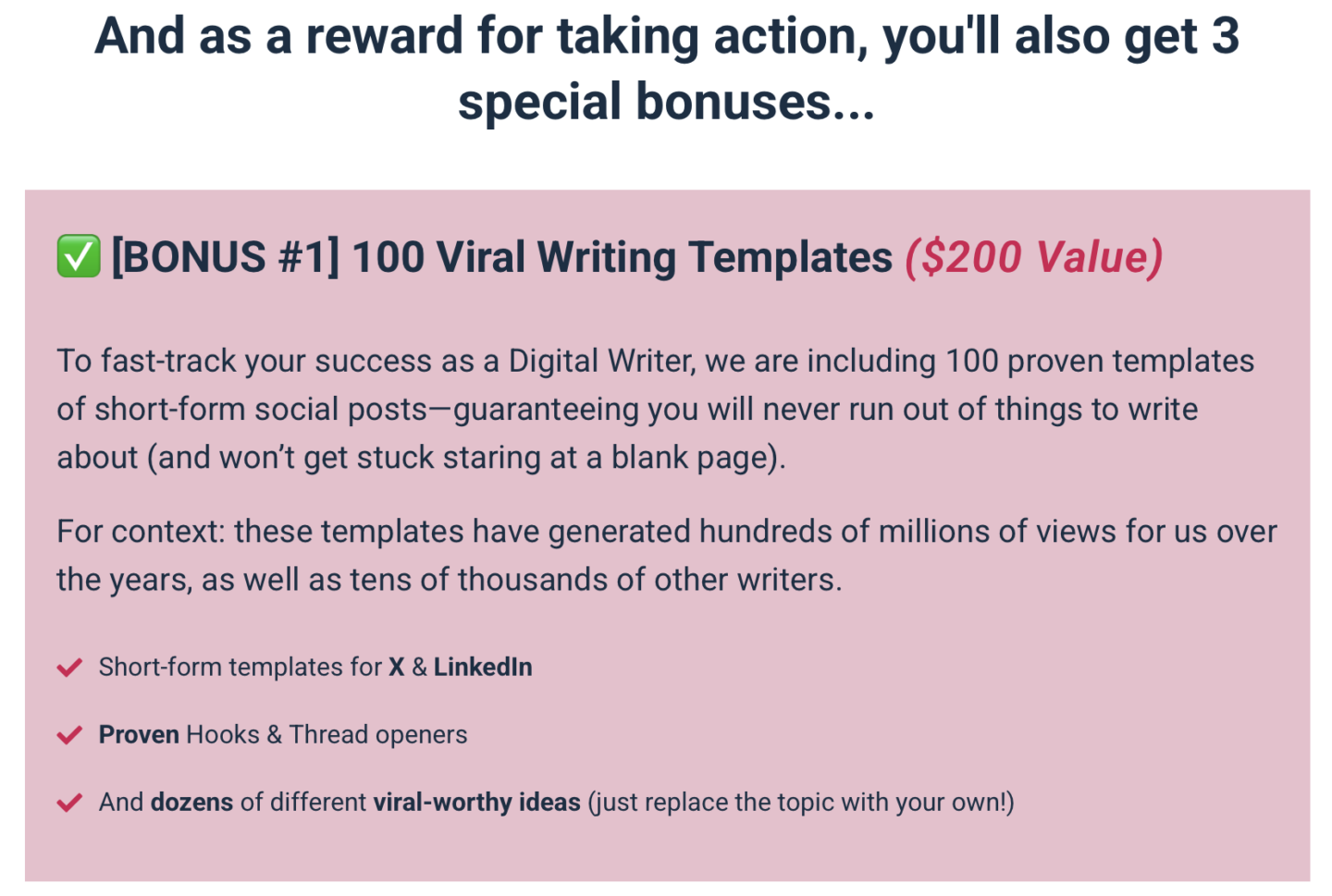
Add “Bonuses,” with attached values, making your Digital Product seem almost… free!
Why “Bonus” Psychology Works
This is a very real thing—and it works on me, and you, every single day.
Pretend you go to the grocery store to buy chips. Really delicious, but expensive chips. The kind that have the perfect amount of cheese and salt and chipotle spice.
You WANT these chips.
But they’re a little out of budget.
You can afford them. They’re just “expensive.”
Then, right next to your favorite chips… you see a small sign.
And that sign says:
BUY ONE, GET ONE FREE!
Well, what do you know… now those “expensive” chips don’t seem so expensive anymore, do they?
This is “Bonus” Psychology at work, where getting something “extra” makes the original thing somehow seem more affordable.
The “Bonus” Psychology Secret
Now, here’s the secret—and where a LOT of writers/creators go wrong when adding Bonuses to their digital product.
You have to attach a dollar figure to the bonus, otherwise it doesn’t hold value.
If you just say, “And by the way, you ALSO get this free thing…!” people don’t value it.
But if you say, “And by the way, you ALSO get this $200 thing for free…!” all of a sudden people feel like they just got $200 for doing nothing.
This tiny nuance is the entire secret to “Bonus” psychology.
List Of Proven Bonuses
So, what could your “free” bonuses be?
Templates: A bundle of assets that helps the person automate or successfully accomplish the core promise of your digital product.
AI Prompts: A bundle of AI prompts that helps the person automate or successfully accomplish the core promise of your digital product.
Automations: A bundle of automations/walkthroughs that helps the person automate or successfully accomplish the core promise of your digital product.
Swipe Files: A collection of proven assets that helps give the person examples of what success looks like/how other people are doing what they’re trying to do.
Behind-The-Scenes: A walkthrough of proprietary information/”how you do what you do.”
Just think of your bonuses as additional, free (with dollar figures attached) digital products/assets.
What ELSE could you build/sell, and how could you give that away for free (again, with a dollar figure attached) with the goal of making your primary digital product seem like an absolute steal?
“But Cole?! I hear you on the bonuses—but how do I know the dollar figure value I should associate with each one?”
Again, go back to the 3 pricing tiers.
And whatever type of asset you are providing the customer in the form of a bonus, ask yourself how much you would charge for that asset if you were to sell it.
Whatever that number is… tell the customer.
“This is what I’d charge for it” aka “This is what it’s worth. But I’m giving it to you for free.”
*NOTE: In an ideal scenario, the combined value of your bonuses should exceed the price of the digital product you’re selling ($350).
Module 1 Exercise
That’s it for Module 1 of Low-Ticket Product Marketing & Monetization!
The exercise here is very simple:
Start with the $350 price point
Ask yourself, “What would I need to show my target customer how to DO in order to rationalize charging $350?” Make a giant list—and make sure this list gets delivered on in the curriculum of your product.
Then ask yourself, “How can I explain the insane value I’m providing, at the laughably low price I’m providing it, by price anchoring $350 to 5x-10x the potential upside for the target customer?” This could be a 5x-10x+ return on their investment in themselves (money), or it could be a 5x-10x+ unlock in saved time, or 5x-10x+ reduced stress, etc.
Lastly, ask yourself, “What 2-3 bonuses, with dollar figures attached, can I add in FOR FREE that would make the cost of my digital product ($350) seem ridiculously cheap?”
If you can answer these questions, and feel good about it within yourself, your digital product is going to be priced to perfection.
Key takeaways
TODO - For Ray